

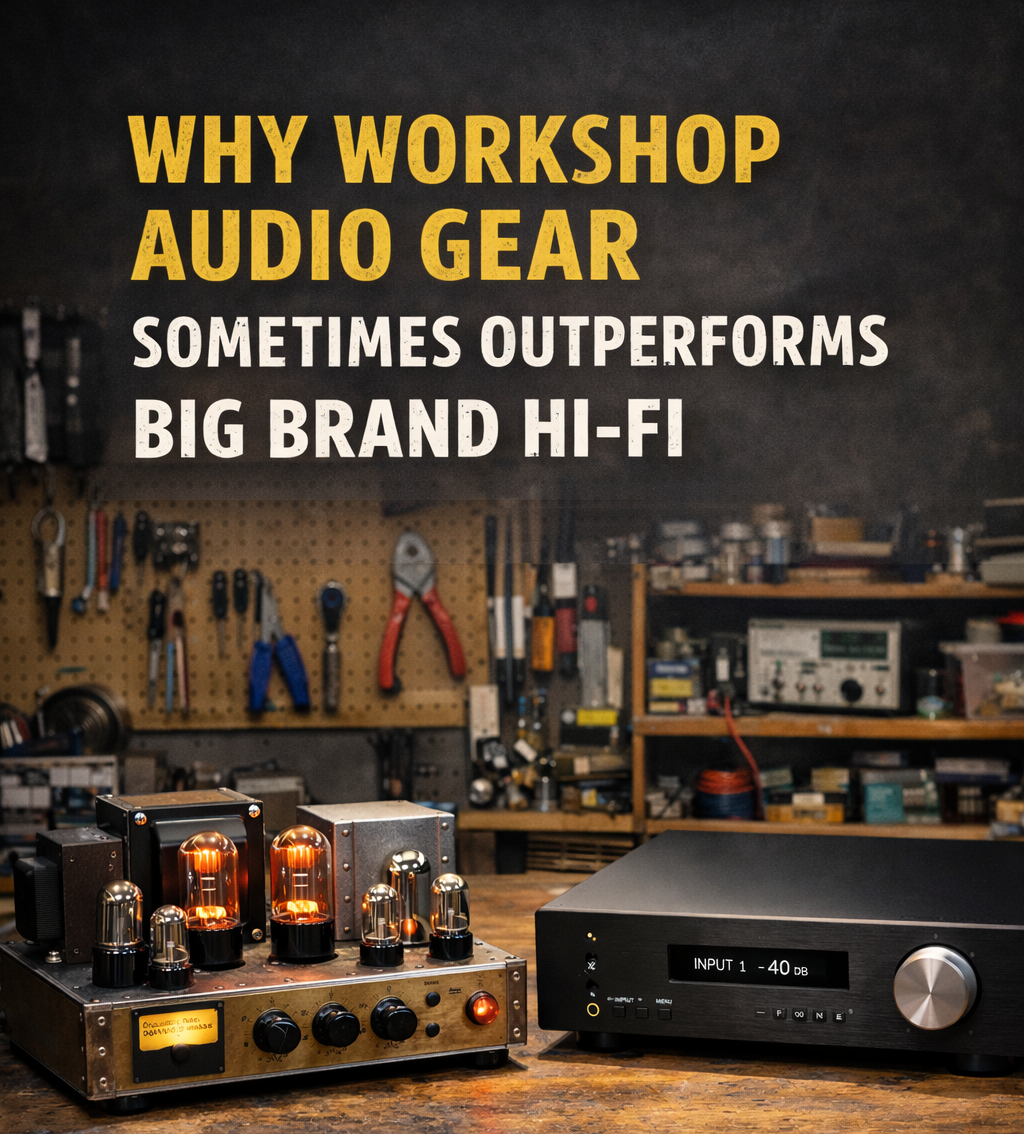




Part 2: Why Workshop Audio Gear Sometimes Outperforms Big Brand Hi-Fi
Boutique and workshop audio builders can sometimes outperform big brands because they may have more creative freedom.
However, this creative freedom also brings trade-offs, including variable quality control, uncertain long-term support, limited documentation, and potential compatibility challenges.
Many people support garage or boutique audio builders because they can experiment freely. This independence sometimes allows their gear to outperform mass-produced hi-fi.
Large manufacturers require stable supply chains, predictable costs, and parts available in bulk, which can restrict innovation.
“Small-scale builders face fewer limitations and can choose rare or specialised components—vintage tubes, boutique capacitors, hand-wound inductors, or custom transformers—mainly for sound quality. These parts might be expensive or difficult to find, but in small batches, they give the equipment a unique character.”
Modern technology has opened even more possibilities. Online communities, 3D printing, CNC machining, and digital modelling make experimenting faster and easier. Builders can collaborate, share measurements, and learn from each other, spreading new ideas more quickly than ever. Enthusiast forums and local meetups also help, offering feedback and shared experiences—but unverified claims can circulate, so critical evaluation is important.
Independent designers can also test unconventional ideas without resistance from corporate management or marketing teams. Even unusual concepts can be explored freely and, if successful, retained, giving the designer greater creative freedom. Yet in practice, many designers still return to familiar approaches.
Many workshop designs embrace minimalism: short signal paths, fewer amplification stages, and circuits without unnecessary processing. Single-ended triode (SET) valve amplifiers are a classic example, using simple circuits to maintain tonal purity. Commercial gear, by contrast, often adds features—digital processing, protection circuits, or multifunction designs—that make the system more versatile but can subtly alter the music’s character.
“These differences are sometimes obvious. In one demo, a simple SET amplifier paired with high-efficiency speakers created a sense of presence that larger solid-state systems struggled to match. Voices and instruments sounded immediate and lifelike, emphasising the value of careful, small-scale design.”
Limited production enables boutique builders to prioritise sound quality over efficiency or marketing. They can explore ideas that large firms might avoid, from rare transformers to unconventional circuits.
“Designers can freely test unusual concepts and retain what works.”
Iterative development is essential: build, listen, tweak, rebuild—small adjustments in components, grounding, or layout can significantly influence the sound.
Craftsmanship is crucial. Each amplifier or speaker is given meticulous attention—wiring is carefully routed to minimise interference, components are precisely positioned, and solder joints are thoroughly inspected. Loudspeakers can be finely tuned by adjusting bracing, damping, and driver alignment. Builders can also personalise equipment for specific rooms by modifying crossovers, enclosures, or amplifier voicing. Many audiophiles find that these tweaks significantly enhance imaging and depth, creating a truly immersive experience. A direct connection between builder and listener allows feedback to influence future revisions, something that is rarely possible with large manufacturers.
Boutique and DIY gear present certain challenges. Quality control and reliability can vary, and small builders often lack access to extensive testing laboratories. Hand-crafted amplifiers might suffer from poor soldering, grounding issues, or mismatched parts, so the outcome heavily depends on the builder’s skill. Long-term support can be uncertain; if a small business closes, servicing may be limited. Rare components that improve sound can complicate maintenance, and resale values are often lower than those of well-known brands, although some high-quality parts may retain their value.
Component choices can affect long-term reliability. Boutique designers often select specialised parts—vintage tubes, unusual capacitors, rare resistors, or custom-wound Transformers—due to their perceived sonic benefits. While these components contribute to a distinctive sound, they can make future maintenance harder. If a rare component fails years later, finding an identical replacement may be difficult. Larger manufacturers generally avoid this problem by choosing parts with stable supply chains.
Long-term ownership can introduce additional uncertainties. Established brands usually offer formal warranties, authorised service centres, and customer support departments to assist with technical issues. Replacement parts and repairs can often be arranged years after purchase through dealers or factory technicians.
Boutique equipment may not offer the same level of long-term security. Many small Manufacturers are usually run by a single designer or a very small team. If an individual retires, changes direction, or closes the business, technical support can disappear quickly.
Even when support remains accessible, servicing may still rely solely on the original builder. This can sometimes lead to longer waiting times for repairs.
Resale value is another factor. Well-known brands typically have a broad second-hand market. Buyers recognise the brand, trust its reputation, and feel comfortable purchasing used Gear. Boutique equipment can be more challenging to sell. Many small brands are recognised only within enthusiast circles, thereby reducing the pool of potential buyers. Prices can fluctuate depending on the designer’s reputation, reviews, and visibility, though high-quality internal components can sometimes maintain value.
System compatibility is another consideration. Large manufacturers design to industry standards, making their gear easy to pair. Boutique designs may require careful matching, such as low-power valve amps requiring high-efficiency speakers. Evaluating performance can be tricky for newcomers, as documentation ranges from detailed measurements to mostly listening impressions. Critical judgment is essential.
In the boutique sector, documentation varies widely. Some designers publish comprehensive measurements and circuit diagrams, while others rely more heavily on listening impressions or descriptive accounts of sound quality.
Despite these challenges, boutique and DIY audio remain popular. Carefully crafted equipment can offer distinctive sound, personalised listening experiences, and a direct connection to the designer’s vision. By combining craftsmanship, experimentation, and freedom from corporate constraints, small builders can sometimes produce solutions that rival—or even surpass—mass-produced systems. For many enthusiasts, the appeal lies in balancing creative potential with the practical realities of ownership.
Part 1: Why Workshop Audio Gear Sometimes Outperforms Big Brand Hi-Fi
Small workshop or DIY audio gear can sometimes outperform big-brand hi-fi because independent builders have the freedom to experiment with unusual designs, specialised components, and hands-on craftsmanship without the commercial constraints faced by large manufacturers.
In a market dominated by ratings and reviews, it is tempting to equate high scores with ultimate quality. Many assume the best-sounding gear comes only from big brands with Global distribution, glossy marketing, and five-star reviews. Yet boutique or DIY equipment built in small home workshops can outperform mass-market products that cost far more. This pattern reflects a mix of history, engineering choices, human perception, and culture. It shows that handcrafted gear can compete with, and sometimes exceed, professional, mass-produced audio.
Imagine settling into a friend’s listening room at an audiophile meet-up. The equipment in front of you doesn’t look particularly impressive. There are no towering aluminium chassis, no glowing corporate logos, and no glossy marketing brochures. Some of the components even look a little homemade.
Then the music starts.
“Suddenly, the sound is startlingly vivid. Instruments seem to appear in the room with uncanny realism. Voices float free from the speakers, and the space around the musicians feels natural and three-dimensional. You sit there wondering how this modest system can sound more engaging than many expensive, highly reviewed setups.”
Experiences like this challenge a powerful assumption: that the best sound must come from the biggest brands with the largest research budgets and the most awards. Yet time and again, carefully built boutique or DIY equipment—sometimes assembled in garages or small workshops—manages to rival, and occasionally surpass, mainstream high-end gear. Understanding why requires looking not only at engineering, but also at the history and culture of hi-fi itself.
The idea of the lone builder working in a garage is deeply embedded in the history of high-fidelity audio. Many famous companies began exactly this way. McIntosh Laboratory was founded in 1949 when Frank H. McIntosh and Gordon Gow began developing amplifiers in a modest Maryland workshop.
Audio Research Corporation emerged when William Z. Johnson started building vacuum-tube amplifiers in a home workspace in the early 1970s.
Meanwhile, Pass Labs developed through years of experimentation by Nelson Pass, who refined amplifier circuits in small workshops before his designs gained international acclaim. Even loudspeaker manufacturer Bowers & Wilkins traces its origins to John Bowers assembling speakers in the back room of a radio shop in Worthing, England.
“Throughout the history of hi-fi, small experimental spaces have often functioned as incubators for innovation.”
Designers working independently can explore unusual circuit ideas, unconventional acoustic approaches, or rare components without the organisational pressures that shape large companies. In many cases, the ideas that later become industry standards first appear in these modest environments.
“Large manufacturers, of course, possess enormous advantages. They can employ teams of engineers, conduct extensive measurements, and invest heavily in research and development.”
But that investment also introduces risk. Developing new components or radically different circuits can be expensive and uncertain. A design that looks promising in theory might prove unreliable in practice, or fail to deliver the expected sonic benefits once it reaches real listening rooms.
Because of these risks, large firms sometimes become cautious. Once a design approach proves commercially successful, it may be refined gradually rather than replaced with something entirely new. Stability and reliability are extremely important when thousands of units must be produced and supported worldwide. Radical experimentation becomes more difficult to justify.
Independent builders operate under very different conditions. With far smaller financial commitments, they can explore unusual ideas more freely. If an experiment fails, the consequences are limited. If it succeeds, it may produce a design that sounds distinctive and surprisingly capable.
Freedom from commercial constraints shapes many aspects of workshop design. Large manufacturers must create products that meet predetermined price points and fit established production processes. Components must be readily available in large quantities, and designs must be manufacturable efficiently. These practical considerations inevitably influence engineering choices.
“A small builder producing only a handful of units can focus far more directly on sonic performance.”
Rare components, unusual circuit topologies, or labour-intensive construction techniques become possible because production volumes are small. The result is often equipment that reflects the designer's personal priorities rather than the marketing requirements of a large company.
Component selection illustrates this difference clearly. Large companies depend on stable supply chains that can deliver parts consistently for many years. Boutique builders, by contrast, can choose components primarily for how they sound. Vintage valves, boutique capacitors, hand-wound transformers, and other specialised parts may all find their way into a design if they contribute to the desired sonic character.
This freedom does not guarantee better results, but it allows designers to pursue very specific sonic goals without the constraints of large-scale manufacturing.
Another defining feature of workshop design is the speed of experimentation. A builder can assemble a prototype, listen carefully, and then modify the circuit almost immediately. Transformer types might be swapped, component values adjusted, or grounding layouts modified. revised within days. If the design produces unwanted hum, distortion, or instability, the builder studies the problem and tries again.
Failure is part of the process. A minimalist amplifier may initially hum due to grounding issues. A loudspeaker cabinet might resonate at an awkward frequency. Through repeated experimentation, the designer gradually learns how small technical decisions influence real-world performance.
Over time, this cycle of building, listening, adjusting, and rebuilding creates a deep practical understanding of the equipment. The resulting designs can become remarkably refined because they have evolved through many small improvements rather than a single fixed development cycle.
The scale of workshop production also enables a level of craftsmanship difficult to replicate in automated factories. When only a few units are built, wiring can be carefully routed to minimise interference, solder joints inspected closely, and mechanical construction adjusted by hand. Sensitive components can be positioned to reduce vibration or electromagnetic noise.
Loudspeaker builders may adjust cabinet bracing, internal damping, and driver placement until the sound feels balanced and natural. These kinds of refinements take time, but they can contribute to subtle improvements in clarity and stability.
“Factories excel at consistency and efficiency, which are essential for large-scale manufacturing.”
Audio reproduction also involves human perception in ways that are not always obvious from measurement charts. The field of Psychoacoustics explores how listeners interpret sound through interactions between frequency balance, harmonic distortion, timing cues, and spatial information. Two amplifiers with similar frequency-response measurements may nonetheless produce noticeably different listening experiences because their distortion patterns or transient behaviour differ subtly.
Many independent designers, therefore, spend long hours listening while refining their equipment. Measurements guide the engineering process, but listening helps evaluate qualities that are difficult to quantify—such as tonal texture, spatial depth, and the sense of musical flow.
Boutique or DIY equipment is not automatically superior to commercial products. Every approach involves trade-offs.
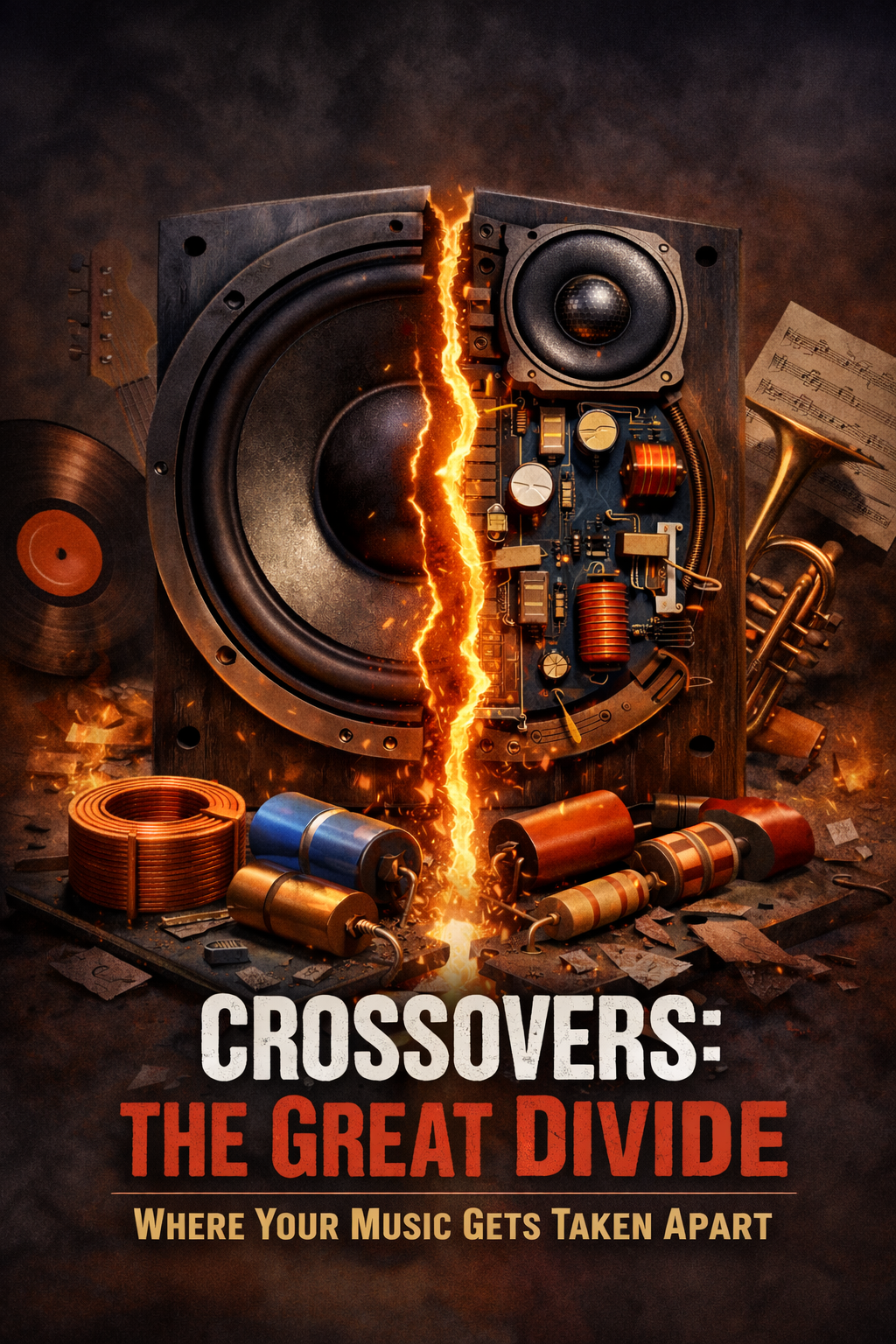
Crossovers: The Great Divide: Where Your Music Gets Taken Apart
Explores the hidden engineering choices shaping everything you hear.
Crossovers: The Great Divide” shows how a loudspeaker’s crossover shapes what we hear. It divides frequencies among drivers, but this can subtly affect phase, timing, and dynamics. Component choices influence harmonic coherence and microdynamics.
Full-range designs improve coherence but sacrifice bass and scale. A well-made crossover lets drivers integrate seamlessly; a poor one leaves persistent flaws in tone, timing, and dynamics.
You lower the needle on Blue by Joni Mitchell, and for a moment, all seems well. Then something unsettles you. Her voice feels fractionally detached from the piano. The top of the vocal floats slightly above the body, and when the piano swells, it arrives with a faint sense of administrative delay. Nothing dramatic. No obvious distortion. Just a subtle suggestion that the emotional message has been routed through different departments before reaching you. While the cause can be attributed to many things, a clever audio friend of yours suspects the crossover.
The crossover receives a full-range music signal—one seamless stream containing bass, midrange, and treble—and decides who handles what. The woofer gets the lows. The tweeter handles the highs. Sometimes a midrange unit sits in between. In principle, this makes perfect sense. Drivers have physical limits. Large cones move air well at low frequencies but struggle to flutter convincingly at 15 kHz. Tiny tweeters can sparkle effortlessly, but would be destroyed by a 40 Hz organ pedal note.
“So crossovers are routinely used to divide the musical signal.”
But dividing something that began as a unified whole (the music) is not without consequences. The crossover is not just a traffic warden pointing frequencies in different directions. It is a network of capacitors, inductors, and resistors—each influencing phase, timing, and dynamics. Each inserts itself between the amplifier and the driver, politely insisting on being heard. Each component has sonic impacts, and not always in a good way.
“Spend enough time around serious audio enthusiasts, and you’ll eventually hear it: the best crossover is no crossover.”
In this worldview, the full-range driver is the heroic minimalist. One cone. One motor. One direct relationship with the signal. No dividing lines. No electrical filters, bending phase, or storing energy. No resistors dissipating precious microvolts as heat. Just the music, handed unedited to a single mechanical entity.
The appeal is not merely ideological; it is audible. When you play something raw and rhythmically unforgiving—say Smells Like Teen Spirit by Nirvana—a good full-range driver can deliver a sense of immediacy that feels almost indecent. The snare cracks without hesitation. The guitar distortion arrives as a single slab of energy, not a composite assembled from multiple sources. Timing feels intact, like a band locked into a groove rather than a committee discussing it.
With no crossover, there is no handover region where two drivers overlap and negotiate. There are no phase rotations around 2 or 3 kHz, and no group-delay anomalies from steep electrical slopes. The coherence—the sense that every harmonic of a note originates from the same physical place—can be intoxicating. A well-recorded acoustic guitar sounds like a single instrument rather than a collaboration between departments.
But physics, unfortunately, doesn’t play nicely. Asking one driver to reproduce 30 Hz to 20 kHz is like asking one actor to perform all roles in a Shakespearean tragedy without changing costumes. It can be done, sometimes brilliantly, but you notice the strain. Bass extension may be limited. High frequencies may beam like a torch rather than disperse gracefully. Dynamics at the extremes of the spectrum can suffer. You gain coherence but may sacrifice scale and bandwidth.
“For most loudspeakers, the crossover remains indispensable.”
At its most basic, a crossover is a set of filters. A capacitor passes high frequencies and blocks lows. An inductor does the opposite. Combine them in different configurations—first order, second order, fourth order—and you create slopes of increasing steepness. Add resistors to adjust levels so drivers of differing sensitivities behave civilly toward one another. On paper, it’s almost elegant.
Software now allows designers to model crossover behaviour with impressive precision. You can simulate impedance curves, predict acoustic summation, and specify target alignments—Linkwitz-Riley, Butterworth, Bessel—with the click of a mouse. The resulting graphs can look beautifully symmetrical, like something you’d frame if you were the sort of person who frames graphs. But loudspeakers are not equations. Drivers do not behave like ideal loads. Their impedance curves resemble mountain ranges. Their frequency responses contain peaks and troughs, some benign, some vindictive. Cones flex. Domes resonate. Cabinets diffract.
You might design a mathematically impeccable 2.5 kHz crossover between midrange and tweeter, confident that the slopes sum beautifully and the simulation behaves itself. On paper, the midrange rolls off smoothly, the tweeter glides in, and the graph looks suitable for framing. But real cones are not perfectly rigid. As frequency rises, they stop moving as one coherent piston and begin to flex in sections—a phenomenon known as breakup. At, say, 3 kHz, the midrange diaphragm may exhibit structural resonance, in which parts of the cone vibrate independently, producing a narrow output peak and increased distortion. If the crossover slope isn’t steep enough—or if the modelling didn’t fully account for that behaviour—the driver’s tendency to ring can bleed above the intended handover point. The result isn’t an obvious calamity; it’s more insidious. Vocals may acquire a faint glare, strings a slightly metallic edge, and brass an unnecessary bite. The mathematics may still look impeccable, but the ear detects that something in the presence region is working harder than it should—a reminder that crossover design is as much about managing the driver’s physical limits as dividing frequencies tidily.
“The tidy model collides with messy reality.”
So you build a prototype. You measure. You listen. You frown. You tweak a capacitor value. You swap an inductor. You move a component physically to reduce magnetic interaction. You measure again. The process is iterative and, when done properly, painstaking. The gap between theoretical modelling and actual acoustic behaviour is not a failure of intelligence; it is an inevitable confrontation with physics.
When this process is rushed—or marketing deadlines loom—the results can be subtle but significant. A crossover that sums flat on-axis may exhibit phase irregularities off-axis, affecting how sound reflects into the room. A small misalignment in acoustic centres can introduce timing discrepancies around the handover frequency. The consequences are rarely dramatic, yet they are cumulative.
Consider a piano note. The fundamental might sit comfortably in the woofer’s domain, while upper harmonics cross into the tweeter’s territory. If the crossover is not perfectly integrated in phase and time, the harmonic structure of that note can feel fractionally disjointed. The body of the note blooms, and a split-second later the shimmer arrives, as though catching up. You might not consciously identify the issue, but you may feel the piano lacks solidity, slightly holographic in the wrong way.
On something texturally complex, like A Moon Shaped Pool by Radiohead, these small errors accumulate. Layers of strings, electronic textures, and falsetto vocals can become faintly congested around the crossover region. Instruments that should occupy distinct spaces begin to overlap in a manner reminiscent of an overenthusiastic group hug.
Phase errors are particularly insidious. Around the crossover frequency, electrical filters rotate phase. If the drivers' acoustic outputs do not align properly, cancellations and reinforcements occur. Measurements show small ripples. The ear hears a slight hollowing or emphasis. Vocals may acquire a nasal quality. Cymbals might sound subtly detached from the kit, hovering an inch above where the drummer left them.
Timing errors—often expressed as group delay—can soften transients. Play an orchestral crescendo from The Rite of Spring by Igor Stravinsky, and instead of explosive propulsion, you might get enthusiasm with a hint of caution. The impact is there, but the edge is slightly rounded, like a knife that could use sharpening.
Dynamics are another casualty of compromise. Every inductor in series with a woofer introduces resistance. Thin-gauge wire, chosen to reduce cost or size, further increases resistance. The result is reduced electrical damping of the driver. Bass may become marginally looser, less articulate. The difference is not night and day; it is the difference between a bass line that grooves and one that merely proceeds.
In many speakers, the tweeter is naturally more sensitive than the woofer or midrange, and without attenuation, it would overwhelm the rest of the system. Designers address this with a resistor, often arranged in an L-pad, which reduces the signal reaching the tweeter. This resistor doesn’t just limit the current; it converts “excess” electrical energy into heat. At normal listening levels, this is unremarkable, but during louder or more complex passages, the resistor can warm and its resistance may shift slightly. The result is a subtle change in the tweeter’s output: cymbals may lose sparkle, sibilants may feel sharper, and the system seems less dynamically responsive. Cheap or undersized resistors amplify the effect, introducing mild compression that isn’t measured on graphs but is heard by the ear. High-quality, thermally stable resistors still dissipate energy as heat—physics insists—, but they do so predictably, preserving tonal balance and immediacy. Padding down the tweeter is necessary for integration but comes with sonic trade-offs revealed in subtle transient detail and microdynamics.
Capacitors, too, are not sonically neutral. Electrolytic capacitors are compact and inexpensive, making them attractive in bass circuits. But they can exhibit higher equivalent series resistance and dielectric absorption compared to quality film capacitors. This can subtly veil detail. On a sparse recording like Pink Moon by Nick Drake, that veil may show as slight greying of the acoustic guitar's harmonics. The intimacy narrows. The space between notes feels less like silence and more like gently used air.
Then there are the prosaic details: binding posts, internal wiring, push-on connectors. These are rarely featured in brochures, which prefer lacquered cabinets and heroic drivers. Yet the signal must pass through these humble components. Plated metals can corrode over time, especially if the plating is thin or the underlying material is reactive. Oxidised connections increase contact resistance. High frequencies may dull. Bass control can slacken. The change is gradual enough that owners often blame ageing ears.
“Even in high-end models—where prices induce mild vertigo—compromises often persist.”
Large air-core inductors wound with heavy-gauge copper are expensive and bulky. Boutique film capacitors cost far more than electrolytics. Precision non-inductive resistors cost more than sand-cast cousins. Across production runs, these costs become substantial. Cabinet space must accommodate the larger crossover. Shipping weights increase. Accountants express concern in design meetings.
None of this implies cynicism. It reflects the reality that every product exists within constraints. But it does mean the crossover—arguably the most influential determinant of how multiple drivers behave as one—is often a battlefield of negotiated compromises. And those compromises have sonic fingerprints.
A thin-gauge inductor in the bass circuit can raise the effective Q of the woofer alignment, subtly altering low-frequency behaviour. The bass may appear fuller but less controlled, adding warmth at the expense of precision. On a driving track like Billie Jean by Michael Jackson, the iconic bass line might lose a fraction of its tautness, becoming slightly more polite than intended.
A budget capacitor in the tweeter circuit can impart a faint grain at high levels. Cymbals lose their metallic sheen and acquire a papery edge. Sibilance on vocals becomes more noticeable not because it is louder, but because it is less cleanly rendered.
Poor internal connections can rob microdynamics. The tiny fluctuations that convey emotion—the slight swell in a bow stroke, the gentle push of breath behind a phrase—become less distinct. Music flattens, not in frequency response, but in feeling.
Against this backdrop, the allure of the no-crossover approach becomes understandable. Removing the electrical network eliminates an entire category of potential errors and cost-cutting. The signal flows directly from the amplifier to the voice coil. Coherence improves. The sense of immediacy can be startling.
Yet full-range systems bring their own physics-related trade-offs: limited bass extension, restricted maximum output, and dispersion anomalies at high frequencies. They may excel at intimacy and coherence while struggling with scale and subterranean authority. Play large-scale orchestral works, and you might admire the unity but miss the foundation.
So perhaps the more useful proposition is not that the best crossover is no crossover, but that the crossover is the most consequential and underestimated element in multi-driver loudspeaker design.
When executed with care—when modelling is tempered by measurement and listening, when component quality matches ambition, when compromises are chosen rather than stumbled into—the crossover can disappear sonically. Drivers integrate seamlessly. Harmonics cohere. Dynamics flow unimpeded. The speaker behaves as though it were a single, impossibly capable transducer.
When executed poorly or excessively compromised, the crossover leaves fingerprints everywhere: in blurred transients, slightly disjointed tonal structures, and a faint sense of congestion when the music becomes complex. It rarely shouts its presence. It whispers it, persistently.
Modern Loudspeakers and the Vintage Alternative: A Reflection on Musicality and Design
A reflective exploration of how modern loudspeaker design prioritises measurement precision, inert cabinets, and complex crossovers, sometimes at the expense of timing coherence and dynamic ease.
It revisits vintage high-efficiency designs, noting their flaws while examining their strengths in midrange presence, immediacy, and harmonic integrity.
It suggests the divide between old and new is less absolute than assumed, and that musicality may lie in combining the strengths of both approaches.
In today’s high-fidelity world, loudspeaker design often feels closer to laboratory engineering than domestic craft. Slim baffles reduce diffraction. Exotic cone materials promise lower breakup distortion. Complex crossovers tame irregularities. Cabinets are sculpted, lacquered, and finished to near-luxury standards. Frequency-response plots, distortion curves, and polar maps are treated as final arbiters of quality.
Measured flatness, low distortion, and controlled directivity dominate contemporary thinking. These are real achievements. Yet many attentive listeners notice something else: technical refinement does not always translate into a sense of musical vitality. Precision is present. Emotional engagement is not always.
Older high-efficiency loudspeakers offer a counterpoint. They were often crude by modern standards. Cabinets resonated. Ports were imperfectly tuned. Crossovers were simple and sometimes imprecise. Drivers could operate beyond ideal bandwidth limits. Yet these designs frequently delivered dynamic immediacy, midrange density, and tonal realism that many modern systems struggle to reproduce. The contrast invites a deeper question: what makes a loudspeaker musically expressive rather than merely technically competent?
Modern Design: Control, Materials, and Measurement
Walk into a high-end audio showroom, and current trends are obvious. Speakers are tall and narrow. Baffle width is minimised to smooth diffraction and improve imaging. Drivers use aluminium, ceramic, beryllium, carbon fibre, or woven composites engineered to push breakup modes far beyond the audible band. Sensitivity is often modest—mid-80 dB/W/m is common—requiring substantial amplifier power.
Crossovers are frequently high-order networks. Steep slopes control driver overlap, flatten the response, and compensate for baffle-step losses. Electrical correction is applied to address mechanical compromises. The result can be impressively flat on-axis response and well-controlled dispersion.
Cabinets receive equal attention. Thick MDF panels, heavy bracing, and constrained-layer damping aim to eliminate enclosure resonance. The goal is inertness. Ideally, the box contributes nothing audible.
These strategies succeed on paper and in many listening rooms. Imaging can be precise. Tonal balance can be even. But certain trade-offs sometimes emerge. Low-sensitivity drivers with heavy cones require more energy to accelerate and decelerate. Steep crossover slopes introduce phase rotation and group delay. Extensive electrical correction can alter transient behaviour.
Flat frequency response does not guarantee temporal coherence. A loudspeaker may appear neutral even though its harmonic components do not arrive perfectly aligned in time. This affects timbre, even when the amplitude response appears ideal.
None of this invalidates modern design. It simply highlights that optimisation in one domain can influence others.
High Efficiency and Dynamic Integrity
Many older loudspeakers were highly efficient, often achieving 95-100 dB/W/m or more. Horn loading, lightweight paper cones, and large radiating areas allowed them to produce significant output with minimal amplifier power.
High efficiency affects more than loudness. It also influences dynamic tracking. When a driver requires less electrical energy to reach a given sound pressure level, the amplifier operates further from its limits. Compression is reduced. Microdynamic contrasts—small fluctuations in amplitude—are preserved. The decay of a piano note, a subtle shift in vocal intensity, or the transient snap of a snare drum remains intact.
Light cones also tend to respond quickly to changes in signals. Acceleration and stopping behaviour are more immediate. This does not automatically mean “better,” but it can contribute to a perception of liveliness.
Modern low-efficiency systems can achieve excellent dynamic performance, especially with powerful amplification. Yet the synergy between high-sensitivity speakers and low-power amplifiers remains compelling. The presentation often feels relaxed yet responsive, rather than driven.
Crossover Simplicity, Phase, and Timing
Older loudspeakers often used low-order crossovers with gentle slopes. Drivers overlapped more broadly. Electrical networks were simpler. This approach introduced amplitude irregularities and greater driver interaction. However, it also reduced phase rotation.
Every filter shift phase. A first-order crossover introduces a 90-degree phase shift. A fourth-order network introduces 360 degrees. Steeper slopes may improve amplitude linearity but increase group delay and temporal displacement between drivers. Even when drivers are physically time-aligned, electrical phase shifts can cause harmonics to arrive slightly offset.
Timbre depends not only on frequency balance but on harmonic structure arriving coherently. When fundamental tones and their overtones are temporally aligned, instruments tend to sound more natural. When alignment is altered, the ear may perceive subtle thinning or textural change, even if the frequency response is flat.
Modern designers often correct phase behaviour with digital processing or physical driver alignment. Some succeed remarkably well. Others prioritise amplitude linearity over time-domain behaviour. Vintage systems, by virtue of their simplicity, sometimes preserved time relationships more naturally, even if frequency plots were less tidy.
This is not an argument for crude networks. It is a reminder that phase, step response, and group delay matter as much as amplitude.
Cabinet Philosophy: Inertness Versus Contribution
Cabinet design marks another philosophical divide. Contemporary speakers aim for maximum rigidity. Thick MDF, extensive bracing, and constrained-layer damping suppress vibration. The enclosure should disappear.
MDF dominates modern construction. It is consistent, easy to machine, and well-damped. Yet no enclosure is entirely inert. Material properties influence energy storage and release. Even heavily damped panels interact with internal air pressure and driver motion.
Older cabinets were often made from plywood or chipboard. Many were under-braced. Panel resonances were measurable and sometimes audible. From a strict engineering perspective, these are flaws. Yet some listeners perceive subtle cabinet contribution as adding tonal density or warmth. That character can sometimes be refined by adding additional bracing or by building a new, better-designed enclosure and transferring the drivers, crossover and wiring to the new enclosure.
The situation is not binary. Modern speakers are not immune to panel colouration. Investigations by companies such as GR Research have shown that even expensive contemporary designs can exhibit measurable cabinet resonances. The broader trend, however, is toward more careful control of enclosure resonances.
What is sometimes overlooked is that enclosure behaviour influences musical presentation in complex ways. Eliminating all resonance may reduce colouration, but it may also alter how energy decays in the room. The ideal balance is not self-evident.
Hybrid thinking is increasingly common. Designers combine high-efficiency drivers with modern enclosure techniques. Wide baffles can be used for bass and midrange energy, while tweeters sit in narrow pods to maintain imaging precision. These approaches challenge the idea that vintage and modern principles must remain separate.
The Midrange and Harmonic Density
The midrange carries most musical information. Voices, strings, and acoustic instruments reside here. Small differences in phase, driver behaviour, and cabinet interaction become immediately apparent.
Many high-efficiency vintage designs used large paper midrange drivers operating within relatively narrow bandwidths. With minimal crossover intervention, harmonic structures often remained intact. The result could be a sense of body and density in vocals and strings.
Modern speakers frequently aim for neutrality through stiff cones and steep filtering. The midrange may measure flatter and cleaner. In some systems, however, the presentation can feel slightly lean, especially when crossover complexity and low sensitivity interact.
This is not a universal rule. Some modern designs achieve both neutrality and density. The point is that measured flatness does not automatically equal perceived fullness. Harmonic coherence and energy distribution across the room also shape the experience.
Real-World Examples: Classic, Modern, and Hybrid
Classic high-efficiency speakers such as the Klipsch Cornwall and La Scala, the JBL L100 and 4312, or the Altec Lansing A7 “Voice of the Theatre” exemplify this older philosophy. They combine high sensitivity, large drivers, and relatively simple networks. Their strengths are dynamic ease and midrange presence. Imaging may be less pinpoint precise. Cabinets are often large and visually plain. Yet they tend to reproduce crescendos without strain and convey instrumental weight convincingly.
Modern precision designs such as the Bowers & Wilkins 800 Series, KEF Reference Series, and Focal Utopia lines pursue different goals. Narrow baffles improve diffraction control. Aluminium or ceramic cones extend the pistonic behaviour. Multi-order crossovers flatten response and manage directivity. The resulting sound can be exceptionally detailed and spatially precise. Bass is controlled. Imaging is stable. In some systems, however, sensitivity is lower and dynamic scaling depends heavily on amplifier power.
Hybrid designs attempt integration rather than opposition. Zu Audio’s Druid series emphasises high sensitivity with minimal crossover complexity. Wilson Audio combines sophisticated enclosures with careful time alignment and higher sensitivity than many competitors. Legacy Audio blends modern cabinet construction with relatively efficient driver arrays. These approaches suggest that efficiency, timing, and enclosure control can coexist.
Listening Impressions in Context
Play “Something” from Abbey Road through a high-efficiency system such as a Klipsch Cornwall. Harrison’s guitar has harmonic richness and tonal weight, with overtones that give each note depth rather than just outline. McCartney’s bass carries weight without effort. Micro-dynamic shifts remain intact at modest volume levels. The presentation feels immediate and dynamically relaxed.
Through a KEF Reference or Focal Utopia, the same track reveals subtle studio details. Imaging sharpens. Harmonics are cleanly separated. Bass lines tighten. The presentation can feel more delineated, though sometimes slightly less dense in the midrange.
On a hybrid system such as a Wilson Audio configuration or Zu Druid, elements of both appear. Harmonic body remains, yet spatial precision improves. Dynamic shifts feel uncompressed, while treble detail stays controlled.
With orchestral music—Bernstein conducting Mahler’s Adagietto, for example—high-efficiency speakers often emphasise dynamic swell and string texture. Modern precision speakers highlight spatial layering and instrumental separation. Hybrids attempt to preserve scale while refining image stability.
With intimate vocals such as Norah Jones’ Come Away With Me, vintage systems often present the voice with harmonic thickness and immediacy. Modern systems reveal micro-detail and recording ambience. Hybrids balance density and articulation.
These differences are not absolute. They are tendencies shaped by design priorities.
Conclusion: Integration Rather Than Opposition
Modern loudspeaker design represents engineering progress. Materials science, computer modelling, and precision manufacturing have expanded what is possible. Yet older high-efficiency designs remind us that musical engagement depends on more than flat response and reduced resonances.
Efficiency influences dynamic integrity. Crossover simplicity affects phase behaviour and timing. Cabinet material and damping shape energy storage and decay. These factors interact in ways that measurements alone may not fully describe.
The most productive path forward may not lie in choosing sides. It may lie in integrating insights. High efficiency can coexist with controlled enclosures. Temporal coherence can be valued alongside amplitude linearity. Imaging precision need not exclude harmonic density.
The goal of high fidelity is a convincing reproduction—sound that preserves timing, dynamics, and tonal structure in a way that feels musically coherent. The conversation between vintage and modern design is not about nostalgia. It is about remembering that musicality has more than one measurable dimension.
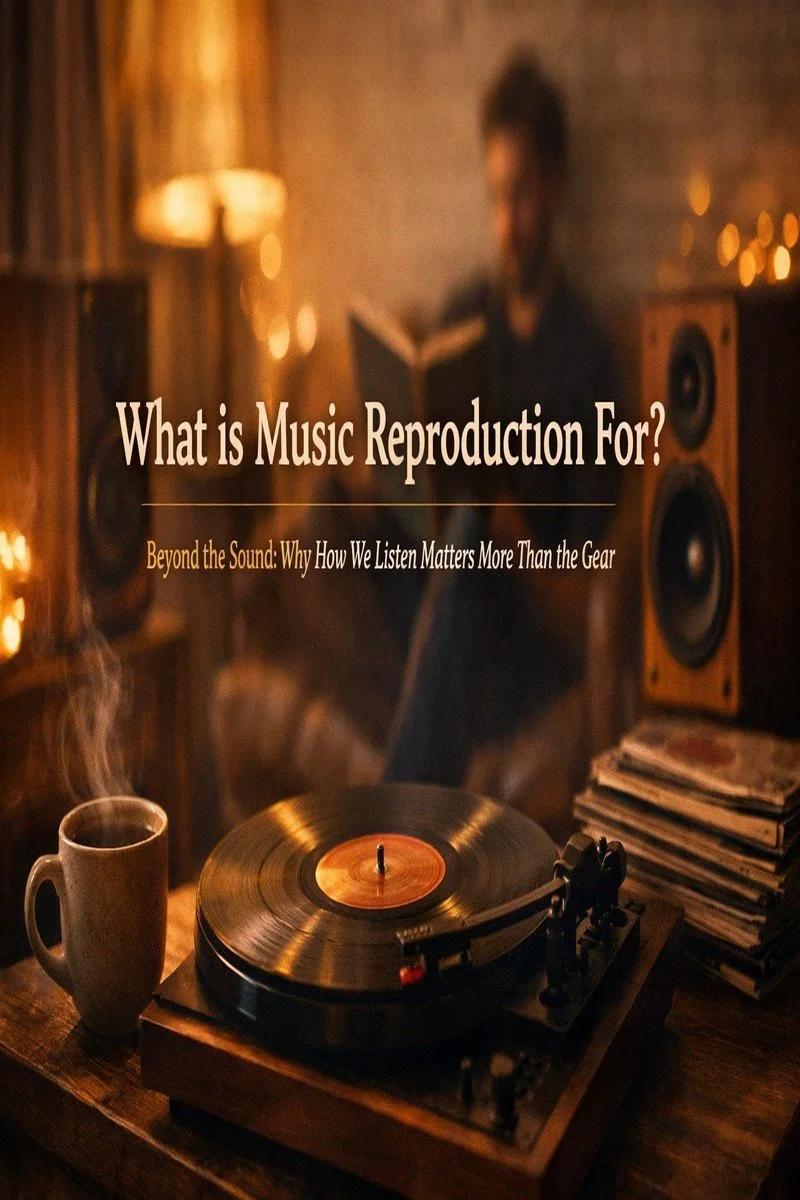
Part 2: What Is Music Reproduction For?
Listening to music is not passive or a test of equipment; it is an active use of attention. As a song unfolds, so do our memories and expectations, creating a personal structure of listening.
Fidelity alone does not create involvement — attention does. In a distracted world, sustained listening becomes a choice to follow one unfolding event. At its best, music reproduction simply clears space for that focus. When we truly listen, we are not just hearing a song; we are discovering the shape of our own awareness within it.
The Structure of Listening
There’s a certain kind of person who can spend nearly an hour deciding what to play and then apologise for pressing. He’ll say things like, “You can really hear the room on this one.” He’ll mention warmth, imaging, and signal paths. Then the music starts, and he stands there, tense, as though the speakers might expose him.
But the real question isn’t about the hi-hat. It’s about us. What exactly are we doing when we listen?
Most people provide pragmatic answers. Music relaxes them. It makes traffic survivable. It helps with the washing up. It stops the gym from feeling like medieval punishment. All fair enough. But those answers make music sound like a ubiquitous household product. Spray lightly over stress. Wipe clean. They miss the fact that listening has a shape. It has rituals. It has habits. It has blind spots. And, while it may be surprising, it even has a moral edge, because it says something about how we choose to spend our time.
“Listening is never just about sound.”
When you play a song you already know, you don’t hear it as you did for the first time. You know the chorus is coming. You know which line hits hardest. You may even remember where you first heard it. The music moves forward, but your mind moves sideways and backwards at the same time. Two things unfold together: the song in real time and your history with it. That double movement is the structure of listening.
Rituals matter. Sliding a record out of its sleeve, setting it on the platter, lowering the needle — it’s not just nostalgia. It’s a way of telling your brain, “Focus, please. Something is about to happen.” Even the faint crackle before the first note isn’t noise. It’s a punctuation mark, a drumroll that says, “Okay, now we begin.” Your mind is already predicting, already ready to catch the surprises that come next. That makes every note hit a little harder.
Listening isn’t passive. The brain doesn’t sit there like a polite guest. It predicts. It guesses what chord is coming next. When it’s right, you feel a small, smug pleasure. When it’s wrong, you feel a jolt. That jolt is the point. Songs play with expectation. They promise and delay. They resolve and refuse. You can own the most precise system in the county. You can position your speakers according to ratios that would make Pythagoras nod approvingly. You can hear every breath the singer takes. And still be bored stiff.
“Fidelity is not the same as involvement. Detail does not guarantee meaning. Attention does.”
A modest system in a small room can feel bigger than a palace of equipment if you’re actually there with it. The gear is a scaffold. It should hold up the experience, not become the experience.
From the first note, your mind gets busy. It sorts patterns. It compares this chorus to others you’ve loved. It checks whether the rhythm matches your expectations. That’s why a familiar pop song feels instantly satisfying. It fits the template with just enough twist to feel fresh. When a song breaks the pattern — drops the beat, shifts the key — you feel it. Not because you studied harmony, but because your inner mental model had to adjust.
People argue about music the way other people argue about politics or football, except with slightly worse evidence. One person insists an album is profound; another says it’s the same three chords dragged out for forty minutes. One clings to the lyrics as if they’re diary entries addressed personally to them. Another couldn’t care less about the words but would happily marry the drummer.
They’re not actually disagreeing about the same thing. They’re listening for different things. One is tuned to confession. Another is tuned to groove. One wants poetry. Another wants momentum. It’s like arguing about a film when one of you went for the script, and the other went for the car chases. When someone says, “It’s brilliant,” and someone else says, “It’s boring,” they may both be right. They’ve simply aimed their attention at different corners of the room. And music contains all the corners at once.
Listening also changes over time. The first time you hear an album, you map the obvious bits: the hooks, the loud parts. By the tenth listen, you notice the spaces between notes, the way the bass leans into a chord, the slight delay before a vocal line. The album becomes familiar terrain. You know where the bends are. Music reshapes time. A three-minute song can disappear before you’ve properly settled into it. A long instrumental can feel as if it exists outside the rest of the day. When you’re absorbed, the clock stops mattering. You’re no longer counting minutes. You’re following a build, a pause, a release. The song’s arc becomes your arc.
What’s unusual is being able to follow something from start to finish without getting yanked away. Most of the day is just fragments — emails, notifications, errands, headlines, a dozen small things demanding your attention all at once.
“You sit down to do one thing, and somehow you’re already halfway through three others. Time feels chopped up, like someone’s taken a pair of scissors to it.”
Listening closely to a record is like discovering a thread through all the noise of your day. For three minutes, ten, or forty, you’re pulled into one single event as it unfolds. You’re not scrolling, not planning, not half-thinking about dinner. Every note, every pause, every shift in rhythm draws you along. Time stretches and bends around the music. You feel it in your body, in your chest, in your head — a steady pulse that belongs entirely to you.
That uninterrupted attention doesn’t just make the song clearer; it makes you clearer too.
You start noticing things you usually miss — a quiet harmony, a whispered lyric, a shift in tension — and in noticing them, you’re reminded what it feels like to really pay attention. That kind of focus, that deep inhabiting of a single shape of sound, is rare, and when it happens, it can feel like the world has momentarily stopped so you can exist fully inside it.
And then there’s listening with other people, which is something else entirely. Picture a few friends crowded around a turntable, a bit too close to the speakers, leaning in as the needle drops.
Everyone goes quiet, not out of fear, just out of habit, like you’re all waiting to see what the music will do.
Nobody checks their phones because, somehow, it feels rude — and besides, it wouldn’t work. That song deserves the room. There’s a particular charm to it. A shared glance when a lyric hits just right. A little laugh when a drum fill comes out of nowhere. Someone taps a foot, another hums along quietly, and in the tiny sync of attention, the people are together. A listening party is a kind of miniature miracle. The music holds the room in place, and in doing so, it turns strangers or friends into a temporary team, a tiny society built from rhythm and breath and anticipation.
The room itself is part of the act. A low-ceilinged living room gives you one story, intimate and conspiratorial; a cathedral of a hall gives you another, epic and awe-inspiring. Reflections, resonance, the way a cymbal echoes off a wall — all of it changes what you notice. The space shapes your perception, but it doesn’t compete with the music. It’s the frame, the stage, the quiet hand guiding your attention so that the song can do its work.
And then there are the tiny, almost invisible things your brain does while you listen. It’s predicting the next note, smoothing gaps, noticing timbre — the hidden flavour of a song that makes it taste richer than you can describe. That’s why a live track can hit harder than the studio version. Rhythm isn’t just beats you tap your foot to; it’s the way the song stretches and compresses time around you. Embodied cognition kicks in — you sway, you tap, you hum. Your body becomes part of the orchestra, your attention a little drumline marching in sync.
Here, Gestalt psychology applies. This is just a fancy way of saying your brain likes to make sense of things. It doesn’t want a bunch of disconnected noises floating around. So even if a song throws in a weird drum fill, a skipped beat, or a vocal that jumps all over the place, your head quietly sorts it out. It glues the bits together, decides what belongs, and smooths the edges so it all feels like one thing.
That’s why a messy, jagged song still makes sense. The sounds made by bass, drums, guitar, and voice don’t arrive as separate packages; they fuse into one shape you can follow. Even when a note drops out or a rhythm stutters, your brain keeps the song moving. It’s like your mind is a helpful stage manager, keeping the show on track even when the performers “go off-script”.
“You’re not just hearing the music, you’re helping make it.”
Each time you listen, you’re piecing together the chaos, turning fragments into a story, filling the gaps, noticing patterns you didn’t expect. The magic isn’t just in the speakers or the studio; it’s in your head, quietly doing its miracle work, so the song hangs together like it was meant to.
And the funny thing is, you barely notice you’re doing it. One moment you’re tapping your foot, the next you realise you’ve been holding your breath through the chorus, or grinning at a lyric that somehow feels like it was written just for you. Your brain has stitched the messy bits together, and suddenly the song isn’t just playing—it’s doing something to you. You’re part of it, the music and your attention in a tiny, perfect collaboration that only exists while you’re really listening.
So what’s music reproduction really for?
“Not to chase some mythical original moment in a studio that no longer exists. Not to prove that your amp can make a cymbal shimmer with forensic precision. Honestly, who cares? The point is simpler, and better: it’s to give you a chance to pay proper attention. To let you actually notice and appreciate.”
A good system doesn’t shout at you. It doesn’t call attention to itself. It steps aside, it clears the way so that the music and you can meet without friction. It gives you breathing room, it allows your mind to settle. A good system doesn’t just reduce random noise; it keeps everything musically balanced. The bass shouldn’t rumble like an earthquake, the mids shouldn’t shout like someone at the back of a pub, and the treble shouldn’t pierce your ears like an alarm. Every register needs to sit in its proper place, clear but not aggressive, present but not demanding. Notes should resolve cleanly, chords should bloom instead of blur, and nothing should get lost in a muddy wash of sound. When the music is balanced like this, the system stops calling attention to itself and starts letting the song do its work. You’re not distracted by the gear; you’re free to follow the rhythm, savour the phrasing, and get lost in the flow.
And then something interesting happens. Memory kicks in, expectation does its little dance, surprise sneaks past your defences, time bends in that familiar, addictive way. The song isn’t just playing anymore; it’s unfolding, and you’re inside it.
“That’s what reproduction is for: not perfection, not proof, but the chance to pay attention properly — to get lost and maybe, just maybe, find a little piece of yourself in the process.”
Without paying attention, music is just there, like a bit of wallpaper you never really notice until it starts peeling off. But when you actually listen — really listen — it’s like a house you can walk around in. You can get lost in the kitchen of a guitar riff, trip over a bassline in the hallway, or curl up in the corner of a lyric that somehow feels like it was written just for you. It’s a place you can live in, and, if you’re lucky, it even teaches you something about yourself along the way.
The record spins. The speakers vibrate. The sound hits your ears, but the real action is happening in your head. Between the music and your mind, something takes shape — invisible, personal, alive. It’s the architecture of attention, the way your focus, memory, and expectation line up with what’s playing.
“And if you stick with it, really stick with it, you realise the magic isn’t just in the song. It’s in the way you listen, the way you inhabit time, notice details, feel surprise, and connect with the music and sometimes with the people around you.”
In that moment, you’re not just hearing music. You’re hearing yourself, or at least a clearer, more alert version of yourself, moving through the shape that sound has drawn around your attention. That’s what real listening is for.
Part 1: What Is Music Reproduction For?
Committing to an album is a quiet act of resistance. It refuses to let music become just another tab in the background. It means choosing to care for forty minutes.
Even the best system can’t take you to Abbey Road but it can reshape the room you’re in.
You sit still, the music unfolds, and the ordinary space around you grows deeper, warmer, more alive.
The Question We Rarely Ask
You know that tiny pause you make when you’re about to press play? It’s that almost-imperceptible moment — hand hovering over a button or a turntable’s needle just above the groove — when you’re trying to remember if you really meant to play something or if you’re just looking for an excuse to not do the dishes? That is, oddly enough, what music reproduction is for: not only playback, not only fidelity, but that brief, unguarded instant when attention chooses sound over the relentless blur of life.
It’s worth lingering on that pause. Because most of the time, when people talk about music reproduction, they talk like it’s a task list: better components, lower distortion, closer to the original recording. All that is fine — if you enjoy spreadsheets. But it doesn’t quite capture why we bother with any of this at all. And it certainly doesn’t explain why a quiet room with a record spinning at 33⅓ can feel, in an odd but very real way, like a refuge.
There’s a piece here in Sound in Life World called “Music as Mindfulness” that touches on this without descending into audiophile mysticism. As Paul James observes, quite practically, that “always connected, always distracted” has become our default mode. Analogue music — vinyl, tapes, live listening — isn’t just sound; it’s a pause. You place a record on a turntable, you lower the needle, you cue up that cassette, and just like that, you are engaging with sound in a way that demands presence. That act, banal as it sounds, is transformative.
Let’s unpack that.
Most of us have been conditioned to think of reproduction as replication. We want the clearest signal, the truest representation, the least amount of stuff between the artist’s intention and our ears. That sense of “closeness” — accuracy to source — has become so ingrained that it’s nearly invisible. But here’s the twist: even if, by some miracle, your system could render every nuance of the original session — every breath, every abrasion of a string, every ambient sigh — you would still not be there. You’d be close in a technical sense, sure, but that wouldn’t explain why you still sometimes hit “next” after a few tracks, or why you keep the volume low, or why a record you’ve heard a hundred times suddenly feels like an event when played in the right room with the right focus.
“Music as Mindfulness” doesn’t pretend to have solved this mystery. It just points out that analogue formats demand a kind of deliberate engagement. They ask for your attention in ways that digital tends not to. And once you start to notice how you listen — the gestures, the expectations, the tempo of your attention — you begin to see that reproduction isn’t primarily about accuracy at all. It’s about presence.
Here’s why that matters: presence isn’t a special state reserved for monks and retreat centres. It’s the simple condition of being here, in time, with sound. It’s that quiet click of mental brakes when you decide to sit with an album rather than reach for your phone. It’s the slight shift in posture as you lean back and let the music unfold, rather than treating it as wallpaper for your to-do list.
And presence is fragile. It’s the thing that gets lost in hectic days, in urgent emails, in the pull of the next notification. Reproduction — good, deliberate reproduction — can restore some of that lost attention. Not by blasting detail into your skull, but by structuring an encounter with sound that rewards focus. A system that shows off every bass note in extraordinary detail might be impressive, but if it leaves you restless after forty minutes, it hasn’t done what matters most. Presence is not measured in decibels; it’s measured in duration and depth of engagement.
When reproduction accomplishes this — when it nudges you toward sustained listening — it stops being a mechanical act and becomes a practice. That’s what the term music as mindfulness gestures toward: listening as an activity with its own pace and space, its own embodied rhythms. You don’t listen to something; you live with it for a while.
And there’s a social dimension too. Listening is often described as a solitary pursuit, but many of the richest listening experiences happen in shared spaces — friends gathered around a stereo, a partner leaning into a couch, quiet laughter over a surprising turn in a record. In such moments, reproduction becomes relational. It anchors conversation, memory, and shared attentiveness in ways that mere background music never will.
So what is music reproduction for? Not just fidelity. Not just convenience. Not merely filling silence with sound. It is, at its best, a practice of presence — an artefact of attention in a distracted world. It offers a structure for listening that calls you out of autopilot and into the music itself. It reminds you that sound isn’t just heard, it’s inhabited.
And if that sounds a little lofty, consider this: you’ve probably experienced it without naming it. That first pause before play. The drop in volume of life’s other noise. The way all of a sudden you’re paying attention to something you already know by heart, and yet it sounds new. That moment — that almost-invisible hesitation — is why we reproduce music at all.
The Sound We Think Is Enough
We like to say what we have is enough — that a phone and earbuds deliver all the beauty we need — and it feels modern, even virtuous. But we’ve adjusted. We’ve grown used to music that lives inside our heads, that never moves air or fills a room. Grandeur shrinks to skull-size. “Fine” replaces beautiful.
Two speakers in a room do what earbuds cannot: they return music to space.
It is peculiar when you say something out loud, it sounds sensible, but it is faintly ridiculous ten minutes later:
“I can spend very little and still get beautiful sound.”
The idea presents itself as freedom, a small triumph of modern life. Freedom from clutter, tangled wires, and the tiny guilt of buying something just to make Bach or Billie Holiday sound better. Because nearly everyone carries a smartphone capable of playing almost any song, the claim feels not just plausible but somehow morally right.
Why would anyone need speakers, amplifiers, DACs, turntables, shelves of vinyl, or the faintly priestly rituals of listening rooms when earbuds and a streaming subscription seem to deliver the same emotional result for the price of a takeaway dinner?
“This is the story we tell ourselves, and it is profoundly wrong.”
Not wrong like conspiracies, but in the quieter, more dangerous sense of feeling correct. Convenience has disguised itself as adequacy, and adequacy has quietly redefined beauty downwards until we can no longer remember what beauty sounded like before it was miniaturised, compressed, and piped directly into our skulls.
Modern listening rests on an unspoken bargain. We trade scale for access, depth for portability, and attention for abundance. Because the trade happens gradually, we barely notice it. The first time you hear music through tiny earbuds, you are amazed that anything emerges at all. The hundredth time, you assume this is simply what music sounds like now. The thousandth time, you feel irritated by anything that demands effort—standing to flip a record, sitting between two speakers, doing nothing else. Convenience becomes not just a feature but an aesthetic, and whatever is easy begins to feel sufficient.
From there, the logic spreads. If earbuds sound “fine,” perhaps speakers are indulgent. If streaming sounds “clear,” perhaps careful recording no longer matters. If music accompanies emails, traffic, exercise, and shopping, listening becomes background infrastructure, like lighting or air conditioning. None of this feels like loss, because loss requires comparison—and comparison requires memory.
Speakers, in the old-fashioned sense—two boxes in a room moving real air—perform a small miracle earbuds cannot imitate. They return music to the world. Sound waves leave the cabinet, travel through space, strike walls, carry weight, and reach not only the ears but also the chest, skin, and sense of orientation. Instruments occupy positions. Silence has dimension. A drum does not tap politely inside the head; it lands in the room. Earbuds reverse this relationship, removing music from space and inserting it directly into the listener. The experience becomes sealed, efficient, internal. Scale disappears, and with it the difference between intimacy and monumentality.
This difference is not merely technical but existential. Listening through speakers is social, even when alone, because the music inhabits shared space. Listening through earbuds is private, even in a crowd, because the music exists only within you.
“Neither earbuds nor speakers are evil, but they are not equal.”
Ask a simple question: how big is a symphony? Through speakers, the answer is obvious—room-filling, horizon-widening, capable of quiet that feels like held breath and of loudness that feels like weather. Through earbuds, scale collapses until everything becomes roughly the size of a head. Quartets, stadium bands, cathedral organs, and tectonic electronic drones shrink to identical proportions. Grandeur becomes imagination rather than sensation. Imagination, left unchallenged, slowly lowers its expectations. Composers chase less. Recordings preserve less. Cultural diminishment arrives not through censorship but through comfort.
Earbuds and headphones encourage multitasking because they are designed for movement, typing, scrolling, and waiting. Music becomes accompaniment, and whatever it accompanies becomes more important.
Speakers invert this hierarchy by asking for stillness and rewarding presence.
“To sit between speakers is to admit that nothing else needs doing, a quietly radical act in a culture suspicious of uninterrupted attention.”
Without such attention, songs shrink to “hooks and fragments”. Albums dissolve into playlists. The long emotional arc of travelling somewhere and returning begins to vanish. We conclude music has become shallow when, often, it is our listening that has.
As reproduction quality falls, listeners adjust downward, and creators follow. Nuance seems pointless if heard through tiny drivers in noisy places. Silence and space disappear under compression. Patience feels risky in a skip-driven culture. A feedback loop forms—reduced listening, reduced production, further reduced listening—until we comfort ourselves that nothing important has been lost because we no longer remember the reference point. This is the real “race to the bottom”, polite enough to pass unnoticed.
Good headphones can mitigate some of these losses by providing increased bandwidth, nuances, and greater intimacy. Yet even the finest still struggle with three things speakers do naturally: externalised space, physical impact, and shared experience. Headphones simulate space, while speakers create it. They describe bass, while speakers deliver it. These are not sentimental claims but perceptual facts. The seductive belief behind all this is that technology always improves while shrinking and getting cheaper.
“Screens and storage obey this rule; sound does not.”
High-fidelity audio remains bound by physics—driver size, air movement, resonance, electrical stability, and room interaction. Miniaturisation can disguise these limits but not erase them. So when we say we already have beautiful sound, we may simply mean we have stopped comparing. Without comparison, fidelity becomes a feeling rather than a reality.
Another force deepens complacency: digital influence. Online personalities promise effortless fidelity, budget miracles, and reassurance that nothing meaningful is missing. Their tone feels like companionship rather than persuasion, enthusiasm repeating until it resembles consensus. Yet the underlying economics reward novelty, speed, and constant upgrading. Nuanced listening does not trend; unboxing does. Durable systems disappear while disposable convenience dominates attention. The burden of proof shifts until attentive listening seems eccentric and shrinkage masquerades as progress.
This is not about blaming individuals or defending expenses. It is about the possibility of being deeply moved by organised sound. Music at full scale—dynamic, spacious, embodied—rearranges inner life, stretches time, and proves attention can be richer than distraction. When reproduction shrinks, that transformative power weakens. Music becomes a pleasant background rather than a necessary presence. Cultures rarely collapse from convenience, but they do thin when their most powerful arts are miniaturised.
Yes, it is possible to spend little and hear something enjoyable, to stream endlessly, and to be constantly accompanied.
“But this is not the same as hearing music fully—feeling scale, air, impact, silence, and patience while sound reshapes a room and, briefly, the self.”
To claim equivalence is to confuse access with experience, clarity with truth, and portability with beauty. Prolonged confusion gradually produces smaller emotional lives.
Perhaps the most quietly subversive act in modern listening is simple: place two speakers in a room, sit down, do nothing else, and play an album from beginning to end. No scrolling, skipping, or optimisation—only time, air, vibration, and attention. What returns is not merely better sound but a fuller relationship to art. It reminds us that beauty is rarely the cheapest, fastest, or most convenient option. Yet when it appears—unhurried and undeniably real—it justifies everything required to hear it and gently reveals that we were mistaken to think we already had it.
The Album: Music That Unfolds in Its Own Time
The Album: Music That Unfolds in Its Own Time celebrates listening slowly and deliberately.
Some records—like Matt Steady’s atmospheric landscapes or Fleetwood Mac’s Rumours—aren’t just collections of songs but carefully constructed worlds. They reveal themselves only if you resist the urge to cherry-pick.
There was a time when listening to music required a small act of surrender. You pressed play and accepted the terms. The artist decided where you’d begin, where you’d wander, and, if all went well, where you’d end up slightly altered. Now we live in the age of the restless thumb, the permanent skip, and the low-grade panic that something better might be happening just ahead. We’ve grown worse at staying put.
That’s why a “digital detox for listening” feels less like nostalgia than self-defence. Some records are not collections of songs but places—carefully lit rooms to explore slowly.
Artists like Matt Steady still make albums this way, constructing worlds with beginnings, middles, and quiet emotional aftershocks that only make sense if you resist “cherry-picking”. To hear them properly requires patience—and the radical belief that the next track exists for a reason.
“In an age of frictionless streaming and algorithmic abundance, Steady’s music offers a counter-practice. It rewards” attention.
It asks for presence. It invites a slower, more deliberate engagement—where albums are not consumed but visited, revisited, and allowed to accumulate meaning over time. His music unfolds gradually, like a landscape revealing itself as your eyes adjust. Listening feels less like entertainment than orientation.
Steady draws on strings, pipes, whistles, and keys, yet no instrument dominates. What lingers is a sense of place—geographical, emotional, sometimes mythic. The music feels weathered, shaped by atmosphere as much as arrangement, as if sounds were discovered outdoors and brought inside. The listener moves through mood, texture, and resonance rather than lyrics. Skip a track, and the terrain folds; stay, and distances begin to make sense.
In an age of endless choice, Steady’s approach is unfashionable. Music often serves as background noise—while walking, scrolling, or replying.
“Steady’s music asks for pause, for time, for sound to be an encounter. It invites you to linger, notice how a chord darkens, how a melody returns altered.”
Fleetwood Mac’s Rumours offers a striking contrast. Where Steady builds landscapes from atmosphere, Fleetwood Mac built an album from the uneasy quiet after love had shifted shape, before anyone knew what came next. Rumours is craft, indeed art—not songs shaped by mechanistic efficiency. The album carries the discipline of people choosing to keep singing together because the alternative—silence—was unbearable. The band sounds less like performers chasing perfection than adults arranging hurt into melodies calm enough to live with. Nothing is forced. Nothing demands resolution. The music lays itself down and trusts recognition to do the rest.
“Its power comes not from drama but from steadiness. From start to finish, sharp edges soften, and separate stories merge into a single landscape shaped by endurance rather than betrayal. Harmonies hold without clinging; rhythms move forward without urgency; endings refuse easy satisfaction.
Rumours doesn’t promise healing—only the subtler possibility that clarity can emerge without noise, and that staying gentle after upheaval can itself be strength.
The album shows us vulnerability, puts those feelings into music, and gives them back—not for sympathy, but so we can see ourselves in them. Love can be the greatest thing you’ve known—or your greatest source of pain. Life is a rollercoaster; how well we navigate the lows shapes the highs. Relationships stumble, fall, and rise in paradoxical ways. In Rumours:
Stevie Nicks pleads, “You can go your own way,” yet longs to be understood.
Christine McVie sings “You Make Loving Fun” to someone who isn’t her husband.
Lindsey Buckingham delivers “Never Going Back Again,” then goes back again in another track.
The album is both fragmented and unified, much like life. Everything flows, nothing stays the same, yet there is beauty in change. It endures because it is honest, taking us to emotional places rarely visited: real trainwrecks, real relationship agonies and ecstasies.
A Different Bar: How True Fidelity Unlocks Musical Insight
Technical measurements—bass, treble, imaging—only tell part of the story. Music is relational and dynamic, shaped by melody, harmony, rhythm, timbre, and silence.
A system that reproduces these interactions holistically preserves structure, nuance, and flow, letting listeners follow phrasing, dialogue, and subtle interpretation.
True fidelity is not about decibels or extension but meaning. The best systems make music intelligible, cumulative, and transformative.
Weaknesses of traditional reviews
Most audio reviews dissect sound into measurable fragments—bass depth, treble sparkle, imaging precision, and distortion figures. These parameters matter, but they do not convey the overall structure, the composition of the music. Music does not exist as isolated frequencies; it lives in relationships: between notes, instruments, tension and release, silence and surge.
“Music is not merely a sum of parts.”
Music is relational, expressive, and dynamic. Melody, harmony, rhythm, timbre, and dynamics interact to convey narrative, intention, and emotion. Music is not simply sound organised in time; it is intention unfolding through relationship. A phrase leans forward or holds back. A harmony darkens the air before it resolves. A rhythmic figure gathers urgency as instruments lock into one another. Space is not an effect but a context in which musicians seem to listen and respond. Dynamics are not volume changes but shifts in emotional temperature.
Meaning emerges from this interplay of interactions—how tone, timing, touch, and silence shape a narrative that moves from tension to release, from question to answer.
A system can excel in extension, clarity, and resolution yet fail to convey the coherence of a performance. Detail may be abundant, staging expansive, and transients crisp—while melodic logic, harmonic tension, and rhythmic interplay remain obscured. Conventional evaluation isolates traits; music itself is never isolated.
“Most audio reviews describe conditions, not consequences.”
The ultimate measure is experiential: when the listener encounters not sound as data but music as meaning.
Component-focused evaluation can reveal detail in isolation but obscures the emergent qualities that give music meaning. Bass may be precise, treble extended, and imaging sharp, yet structural relationships, emotional subtleties, and performer interactions remain flattened or invisible. A technically “perfect” system may leave listeners hearing more, but understanding less.
What Holistic Reproduction Enables
A system that reproduces music as a whole preserves music’s relational interactions. It maintains continuity of melodic line, harmonic proportion, dynamic shading, spatial coherence, and temporal elasticity. The listener perceives not isolated sonic traits, but coherence, intention, and expressive flow.
Holistic reproduction fosters comprehension, empathy, and engagement. The listener can follow the arc of a phrase, trace interpretive decisions in timing and touch, and sense ensemble dialogue. Repeated listening deepens insight: motifs and structural patterns emerge, subtle phrasing and microdynamic nuance register, and emotional subtleties—tension, release, fragility, joy—become palpable. Music becomes cumulative knowledge, an active learning process rather than passive consumption.
A system succeeds when it enables listeners to perceive musical dialogue, emotional nuance, and narrative trajectory. Here, technical excellence recedes from awareness, leaving only the music’s expressive truth.
“In holistic reproduction, clarity serves meaning; technical fidelity is a tool, not the endpoint.”
In jazz, holistic reproduction reveals improvisational reasoning. In The Köln Concert, Keith Jarrett’s rubato and harmonic exploration form a spontaneous narrative; the logic of each choice becomes clear when timing, decay, and dynamics are preserved.
In symphonic music, Bernstein’s Mahler Fifth demonstrates how dialogue between orchestral sections shapes thematic development and the emotional arc. Strings, winds, and brass exchange ideas, building tension and release. A reductive system may reproduce scale and impact, yet obscure the unfolding structural conversation.
In vocal performance, Maria Callas’s phrasing, breath, and vibrato communicate dramatic intent. Only when the dynamic and spatial context is preserved does the listener apprehend expressive nuance rather than mere tone.
Across all genres, the difference with holistic reproduction is not more sound—it is more understanding. Here, music becomes cumulative knowledge, revealing itself over time. It teaches as much as it entertains. This sets a different standard than conventional review criteria.
Art Dudley’s Insights
The late Art Dudley argued that the highest value in audio lies not in isolated metrics but in how fully a system communicates the music itself. Technical excellence is essential—but only as a means, not an end. Systems should make music intelligible and emotionally resonant. allowing listeners to perceive dialogue, structure, and expressive nuance without distraction.
A system succeeds when it enables listeners to perceive musical dialogue, emotional nuance, and narrative trajectory. Dudley referred to this as “musical transparency”—the point at which technical excellence fades from awareness, leaving only the music’s expressive truth.
Contrast this with conventional, reductive approaches. Component-focused evaluation can reveal detail in isolation but obscures the emergent qualities that give music meaning. Bass may be precise, treble extended, and imaging sharp, yet structural relationships, emotional subtleties, and performer interactions remain flattened or invisible. A technically “perfect” system may leave listeners hearing more but understanding less.
“In holistic reproduction, clarity serves meaning; technical fidelity is a tool, not the endpoint.”
For Dudley, meaningful listening occurs when equipment disappears, and the performance emerges as a coherent, living act. A system succeeds when it clarifies musical dialogue, structural development, and interpretive subtlety, making art legible rather than merely impressive.
A Different Standard
This establishes a fundamentally different evaluative bar. Traditional metrics ask: How accurately does the system reproduce sound? A more musically grounded question asks: How fully does the system communicate what the musicians are doing and why?
Assessment under these standards centres on comprehension, empathy, and engagement:
Comprehension: Can the listener follow narrative arc, understand relational interplay, and recognise structural patterns?
Empathy: Does the system convey touch, timing, phrasing, and emotional intent?
Engagement: Does the performance sustain attention, emotional investment, and insight over repeated hearings?
Ultimately, the listener’s experience is the benchmark of value. Holistic reproduction enables music to function as a living narrative, an educative experience, and an emotional journey. Understanding, insight, and affect are inseparable. Systems that achieve this raise the bar far beyond technical perfection—they create a space where the music itself becomes legible, instructive, and transformative.
TYhe highest fidelity is not measured in hertz or decibels but in meaning conveyed. A system succeeds when music functions as knowledge, dialogue, and emotional experience—when technical clarity serves expressive truth rather than standing as an end in itself.
“Music becomes intelligible, cumulative, and transformative; listening becomes an act of discovery.
That is the different bar: not sound in isolation, but music understood.”
Beyond Thump and Tizz:
The late Art Dudley’s had a gift for cutting through audiophile obsession to show what matters in sound. He knew systems with thumping bass or sparkling treble could thrill—but only in the wrong way, sidelining the music. The “tyranny of the frequency extremes” values extension over coherence, specs over musical reality.
Coherence is key: a system should behave like a single instrument, with harmonics intact and no part calling attention to itself. Frequency extremes only work if they serve the whole; otherwise, they dazzle briefly and disappoint.
The Tyranny of Frequency Extension in Hi-Fi

Art Dudley
The late Art Dudley knew a sound that grabs you in all the wrong ways, demanding attention before the music has a chance. A system whose bass thumps and treble tizzes so insistently that the music itself doesn’t get a look in.
At first, it feels thrilling. The bass stomps as if it owns the room. The treble sparkles in a metallic, edgy way, as though each note has been etched into the air itself.” For a few seconds, you can’t help but pay attention. And then you wonder why you’re not listening to anything.
Dudley didn’t trust that moment.
He had a way of naming things so plainly that you wanted to slap your forehead and say, Of course. When he wrote about “the tyranny of the frequency extremes,” he wasn’t attacking bass or treble per se—they’ve always been part of the fun—but the obsession with extension as proof of quality. Lower, higher, cleaner, flatter. Specs standing in for experience. He once said, with a kind of dry exasperation, “Audiophiles are easily impressed, and often by the wrong things.”
Sure, the bass hits hard. You feel it in your chest, pounding the floor. But if it’s muddy or arrives a fraction late, it erodes the meaning of the music—you might sense the rhythm, but phrasing, pulse, and emotional nuance start to slip away. Treble can sparkle and spray, with metallic sounds that demand attention. But if it’s disconnected from the notes, it’s not music—it’s decoration, detail without meaning.
The real heart of the sound, Dudley reminded us, lives in the middle. Voices, strings, woodwinds, and brass—everything with texture, weight, and expressive nuance—occupy this midrange, anchored in the mid-bass, where timing and phrasing come alive. Get it right, and a system with quirks elsewhere can still convey music that feels real. Get it wrong, and no amount of thump or tizz can save it. The music loses coherence, and the listener loses the connection.
This is where coherency matters. Dudley saw it not as a flat frequency response, but as a system behaving like a single instrument: sounds start and stop together, harmonics stay intact, nothing calls attention to itself. “Music is one thing happening,” he said repeatedly, “not many things happening at once.”
When coherency is absent, the seams show: bass drifts from pitch, midrange loses density, treble floats like commentary rather than content. The illusion of real musicians in a real space quietly collapses.
Achieving this coherence is difficult. It requires restraint, alignment, and integration—not just flat response or extreme extension. Crossovers introduce phase issues; multiple drivers must be timed, not just tuned. Feedback can flatten life as well as response. Dudley admired designers who accepted limits to preserve unity.
That’s why he favoured simpler systems: fewer promises, but the right ones. “I don’t mind less,” he seemed to say, “if what I get makes sense.” Less thump, if it speaks clearly. Less tizz, if it belongs to the instrument producing it.
Frequency extremes weren’t unimportant. But Dudley refused to elevate them above everything else. Extension should emerge naturally from a coherent, musically grounded system—not be chased in isolation. When priorities are inverted, systems dazzle briefly and disappoint slowly.
And that explains who he was really writing for. Not labs. Not spreadsheets. Music lovers. People who sit down at night, drop a record, and care about what it feels like when the music starts. That was always his measure: not how far down it went, not how high it reached, but whether it made you reach for the next record.
The tyranny of the frequency extremes is, at heart, a reminder: don’t be distracted by thump and tizz. Remember the middle. Remember coherency. Remember what makes reproduced music feel real, lifelike, and utterly worth returning to.

Audio Myths and Truths
What is taken as true might be a myth, and what is taken as a myth might actually be true.
THis is a test

Musical Enchantment: Finding Magic in Music Experiences
Musical EnchantmentMusical enchantment—the feeling of being swept away by a melody, immersed in harmonies, or transported by sound—is rarely discussed in music blogs or audio magazines, which focus instead on measurable qualities like frequency, clarity, or fidelity.
Yet this sense of wonder is central to what music does: it suspends time, heightens awareness, and creates deeply personal, visceral experiences that engage memory, imagination, and the body.
Why Musical Enchantment is Rarely Discussed
Music blogs and audio magazines often focus on gear, formats, or sound quality—but rarely on the magic of music.
That sense of wonder—being swept away by a melody, immersed in harmonies, or transported by sound—rarely appears in reviews or editorials.
Outlets that focus on reproduction and equipment naturally highlight what can be measured: frequency ranges, signal clarity, speaker fidelity. These are tangible, objective, and comparatively easy to compare. Enchantment, by contrast, is slippery. It lives in the listener, in the moment, and is difficult to describe, let alone measure. For editors and writers whose readers expect quick, digestible information, the ineffable often gets “pushed aside”.
“Nevertheless, the true power of music is not just what it is, but what it does—how it changes the way we feel, perceive, and inhabit the world.”
What the Experience Feels Like
Experiencing musical enchantment is immersive and often ineffable. Time can feel suspended, and awareness expands to encompass every nuance of tone, rhythm, and silence. You may be carried along by a wave of emotion you cannot fully name. It is deeply personal: the same piece of music can enchant two people in completely different ways, yet for each listener, the effect is visceral and undeniable. The experience is multidimensional, involving memory, imagination, and physical response—the chill that runs down your spine, the urge to sway to the rhythm, or the way a certain chord triggers a long-forgotten memory. Enchantment is felt as much in the body as in the mind.
Why Musical Enchantment Matters
The power of musical enchantment extends far beyond fleeting pleasure. It fosters deep emotional awareness and helps us connect with feelings that are otherwise hard to articulate. It sparks creativity, offering new perspectives and opening mental space for reflection. It nurtures empathy, as experiencing music’s emotive power enables us to inhabit others' worlds and experiences. Moreover, it provides mental and emotional restoration—a pause from the noise of daily life where one can be fully present with sound. In these ways, musical enchantment is not just a moment of delight; it is a profound human experience that enriches perception, sharpens imagination, and reminds us why music matters.
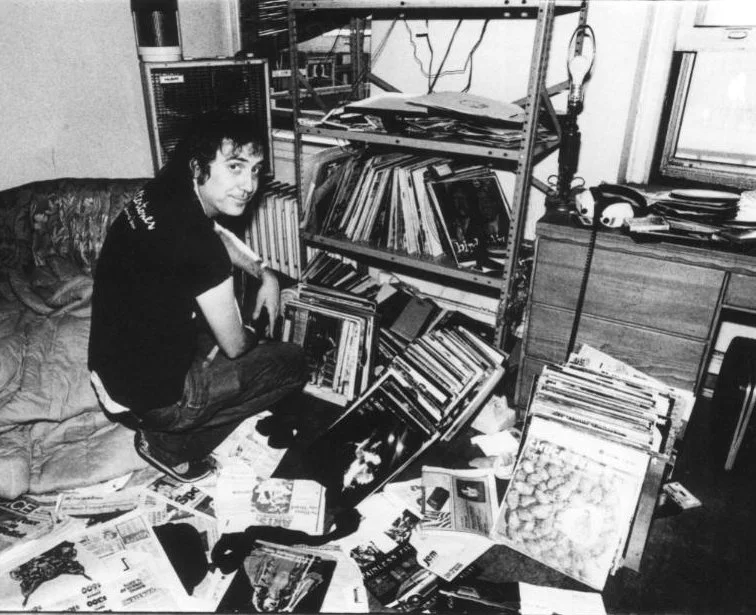
Why Music Criticism Still Matters
In an era of endless streams and viral clips, serious music criticism remains vital. While platforms like YouTube, TikTok, and Spotify make opinions instant and music endlessly accessible, thoughtful criticism teaches us to listen deeply, notice subtle details, and understand why songs matter. Beyond rankings or stars, critics connect music to culture, history, emotion, and society, giving it context and resonance.
Voices like Lester Bangs or Greil Marcus didn’t just describe sound—they captured energy, insight, and meaning, giving music a “second life” in words.
In a world of endless streams and viral clips, serious music criticism is disappearing—but it has never been more essential. Thoughtful critics help us listen deeply, understand why music matters, and experience songs fully.
“Good critics listen closely, think deeply, and write in ways that help others experience music more fully.”
Platforms like YouTube, TikTok, Spotify, and Reddit make sharing opinions instant. With a few taps, we can stream millions of songs, read immediate reactions, or watch someone respond to a track in real time.
Yet something vital is fading: deep, thoughtful criticism. Criticism isn’t just ranking songs or giving stars. At its best, it teaches us to listen closely, think deeply, and experience music fully.
The best critics connect music to culture, history, emotion, and society. They show how songs reflect the world and invite us to notice subtle details.
Decades ago, critics shaped how people discovered and experienced music. Writers like Robert Christgau, Greil Marcus, and Lester Bangs helped generations understand rock, pop, jazz, and punk. Some had formal training; others came from different backgrounds. All shared the ability to guide attentive listening.
“Raw Power is one of those records that doesn’t just get inside your head, it tears your head open… This is not music for polite listening; it’s music that demands you feel every jagged nerve, every sharp edge” Lester Bangs on Iggy and the Stooges
Bangs captured energy, not just quality. His criticism gave music a “second life” in words, showing why it matters. Without such voices, music risks becoming background noise, shaped only by algorithms.

The Impact of Losing Traditional Music Criticism
The decline of traditional music criticism has left a gap often filled by influencers, memes, and algorithm-driven content, where insight is secondary to virality.
Yet reflective criticism is more essential than ever:
Critics illuminate not just the music itself but how it is created and experienced, showing how production, formats, and equipment shape emotional and perceptual impact. By guiding attentive listening, they help music move beyond background noise into meaningful, memorable experiences.
Today, full-time critics are rare. Media organizations rely on influencers, fan-driven platforms, and algorithmic content. Online commentary often prioritizes entertainment, virality, or branding over insight. Hot takes, memes, and reaction clips dominate. Thoughtful, researched reviews frequently get buried.
“Yet reflective criticism is more essential than ever. Critics slow us down, broaden our horizons, and introduce listeners to unknown artists, unfamiliar genres, and new perspectives.”
Yet reflective criticism is more essential than ever. Critics slow us down, broaden our horizons, and introduce listeners to unknown artists, unfamiliar genres, and new perspectives.
Critics illuminate how music is created and experienced. Writers like Art Dudley, Herb Reichert, and Jeff Day emphasize production, formats, and equipment. Switching from earbuds to a high-quality system transforms music emotionally. Critics make us aware of these subtleties and show how technical choices shape experience.

Modern Voices in Music Criticism
Contemporary Music Criticism
In a fast, algorithm-driven world, critics are vital. They help us:
Listen fully, not passively
Understand why music matters
Break out of algorithmic comfort zones
Appreciate nuances in sound, performance, and emotion
Music criticism keeps listening alive, awake, and human. It reminds us that music is more than entertainment—it is a rich, lived experience deserving attention, care, and reflection.
Some creators continue the tradition of thoughtful criticism.
Amy Shafer (Virgin Rock) combines deep listening with emotional openness. Her “first listen” gives an honest reaction, followed by technical analysis. In her review of Black Sabbath’s 1970 track Black Sabbath, she explains the tritone interval and its eerie effect, connecting theory to emotional impact.
PM Coleman (The Positivity Corner) offers a reflective alternative to viral reaction videos. She celebrates music with sincerity, drawing on decades of listening. Her videos focus on artists like Curtis Mayfield, Gladys Knight, and Bill Withers. Her deliberate pace invites viewers to experience music thoughtfully.