

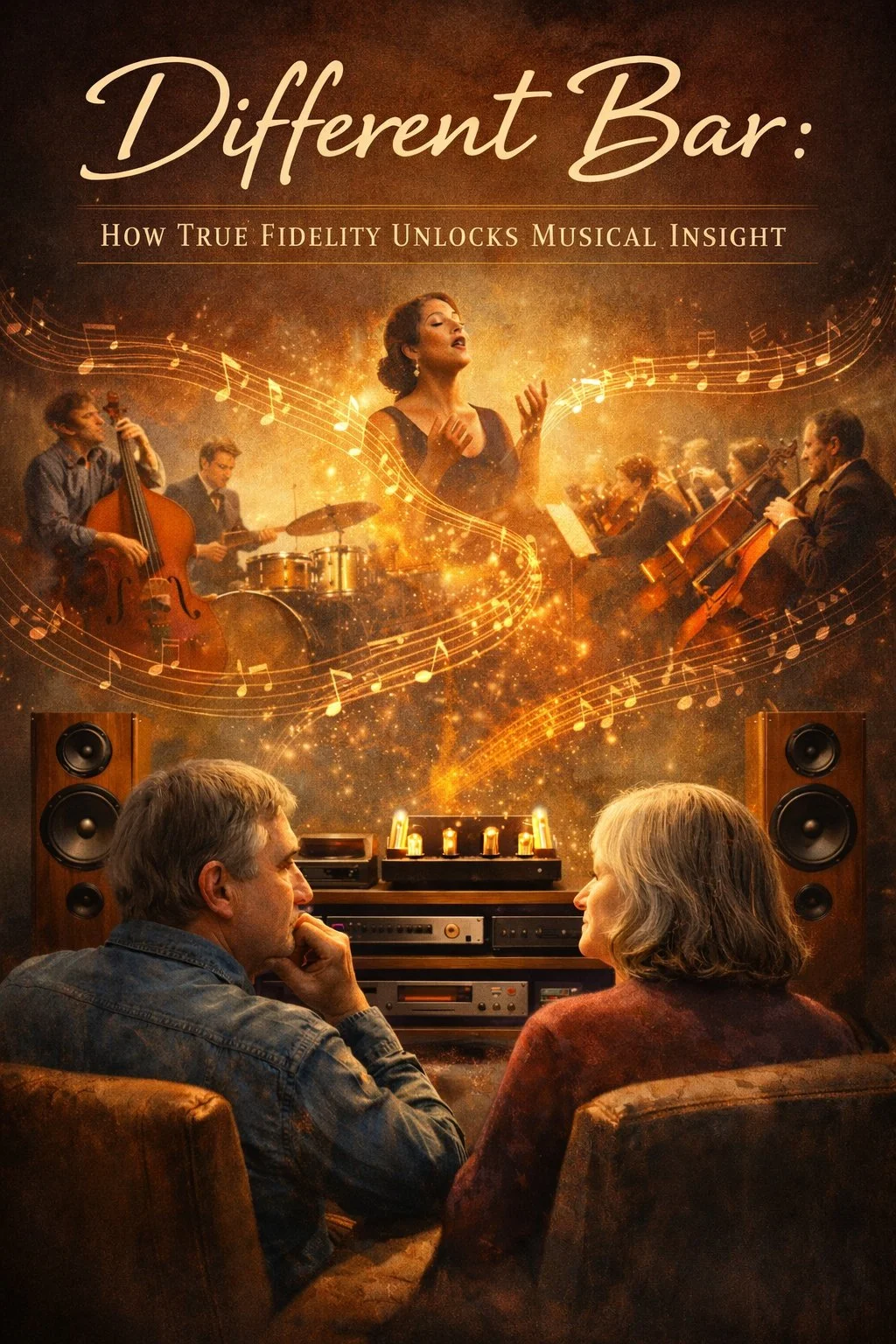
The Sound We Think Is Enough
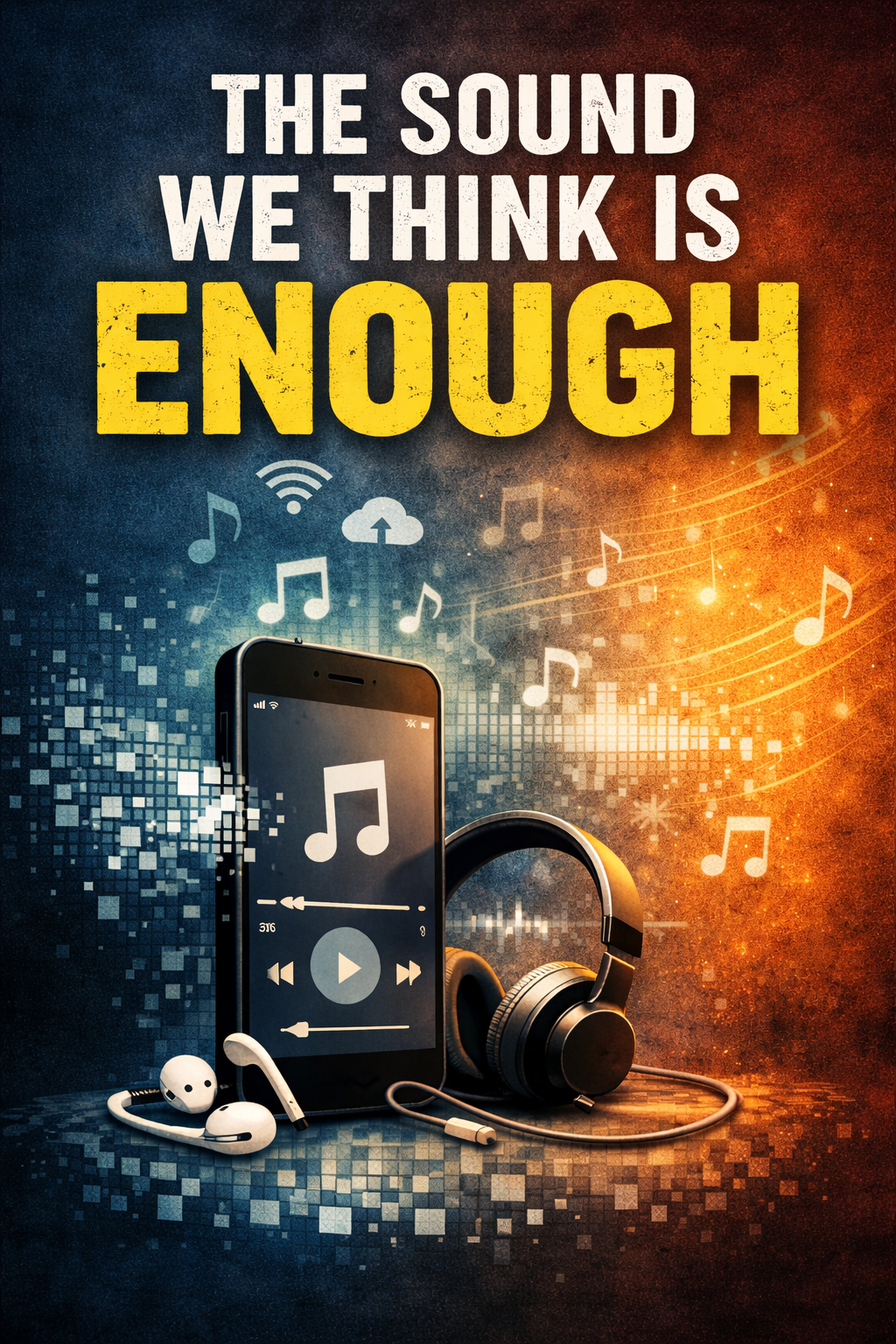
We like to say what we have is enough — that a phone and earbuds deliver all the beauty we need — and it feels modern, even virtuous. But we’ve adjusted. We’ve grown used to music that lives inside our heads, that never moves air or fills a room. Grandeur shrinks to skull-size. “Fine” replaces beautiful.
Two speakers in a room do what earbuds cannot: they return music to space.
It is peculiar when you say something out loud, it sounds sensible, but it is faintly ridiculous ten minutes later:
“I can spend very little and still get beautiful sound.”
The idea presents itself as freedom, a small triumph of modern life. Freedom from clutter, tangled wires, and the tiny guilt of buying something just to make Bach or Billie Holiday sound better. Because nearly everyone carries a smartphone capable of playing almost any song, the claim feels not just plausible but somehow morally right.
Why would anyone need speakers, amplifiers, DACs, turntables, shelves of vinyl, or the faintly priestly rituals of listening rooms when earbuds and a streaming subscription seem to deliver the same emotional result for the price of a takeaway dinner?
“This is the story we tell ourselves, and it is profoundly wrong.”
Not wrong like conspiracies, but in the quieter, more dangerous sense of feeling correct. Convenience has disguised itself as adequacy, and adequacy has quietly redefined beauty downwards until we can no longer remember what beauty sounded like before it was miniaturised, compressed, and piped directly into our skulls.
Modern listening rests on an unspoken bargain. We trade scale for access, depth for portability, and attention for abundance. Because the trade happens gradually, we barely notice it. The first time you hear music through tiny earbuds, you are amazed that anything emerges at all. The hundredth time, you assume this is simply what music sounds like now. The thousandth time, you feel irritated by anything that demands effort—standing to flip a record, sitting between two speakers, doing nothing else. Convenience becomes not just a feature but an aesthetic, and whatever is easy begins to feel sufficient.
From there, the logic spreads. If earbuds sound “fine,” perhaps speakers are indulgent. If streaming sounds “clear,” perhaps careful recording no longer matters. If music accompanies emails, traffic, exercise, and shopping, listening becomes background infrastructure, like lighting or air conditioning. None of this feels like loss, because loss requires comparison—and comparison requires memory.
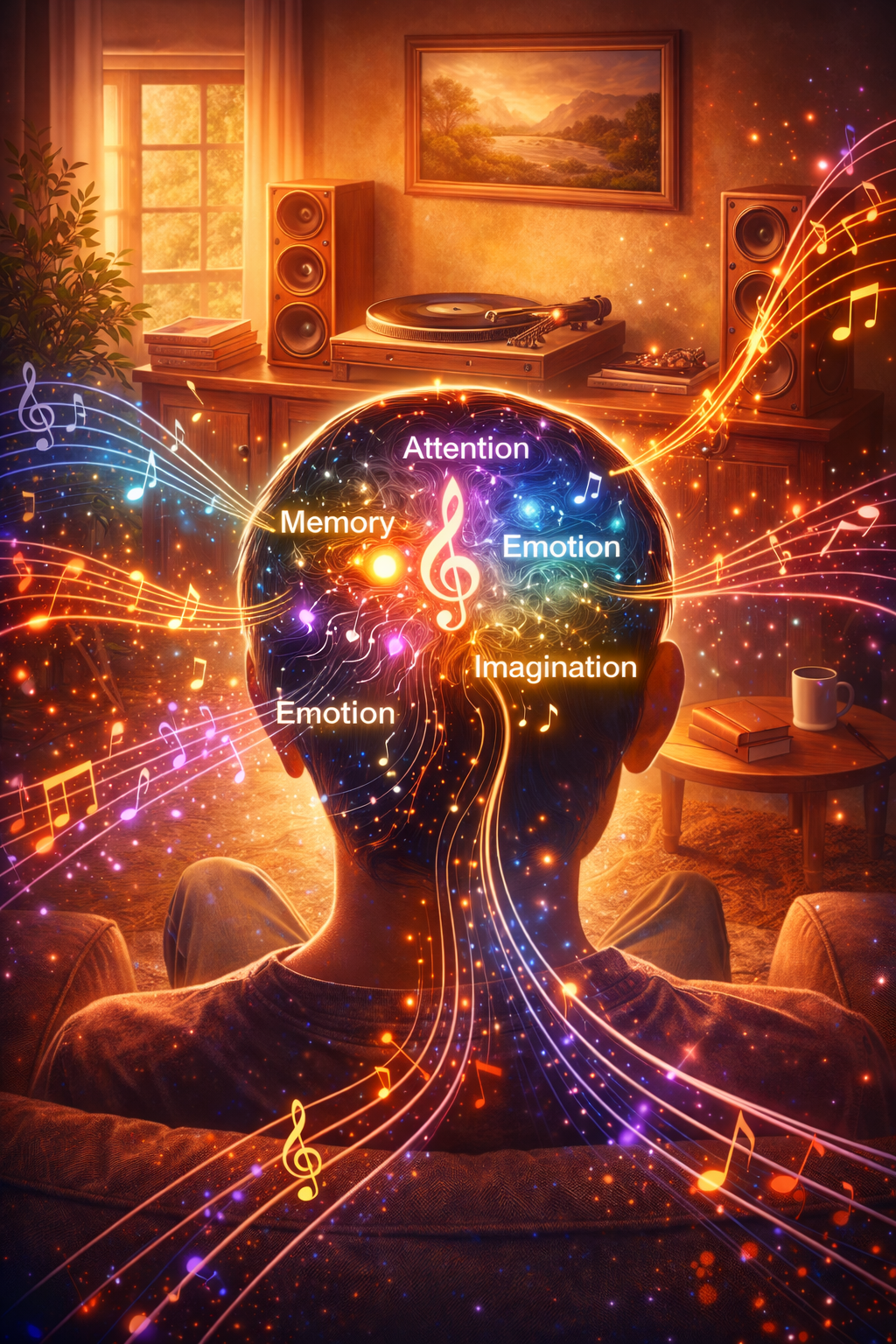
Speakers, in the old-fashioned sense—two boxes in a room moving real air—perform a small miracle earbuds cannot imitate. They return music to the world. Sound waves leave the cabinet, travel through space, strike walls, carry weight, and reach not only the ears but also the chest, skin, and sense of orientation. Instruments occupy positions. Silence has dimension. A drum does not tap politely inside the head; it lands in the room. Earbuds reverse this relationship, removing music from space and inserting it directly into the listener. The experience becomes sealed, efficient, internal. Scale disappears, and with it the difference between intimacy and monumentality.
This difference is not merely technical but existential. Listening through speakers is social, even when alone, because the music inhabits shared space. Listening through earbuds is private, even in a crowd, because the music exists only within you.
“Neither earbuds nor speakers are evil, but they are not equal.”
Ask a simple question: how big is a symphony? Through speakers, the answer is obvious—room-filling, horizon-widening, capable of quiet that feels like held breath and of loudness that feels like weather. Through earbuds, scale collapses until everything becomes roughly the size of a head. Quartets, stadium bands, cathedral organs, and tectonic electronic drones shrink to identical proportions. Grandeur becomes imagination rather than sensation. Imagination, left unchallenged, slowly lowers its expectations. Composers chase less. Recordings preserve less. Cultural diminishment arrives not through censorship but through comfort.
Earbuds and headphones encourage multitasking because they are designed for movement, typing, scrolling, and waiting. Music becomes accompaniment, and whatever it accompanies becomes more important.
Speakers invert this hierarchy by asking for stillness and rewarding presence.
“To sit between speakers is to admit that nothing else needs doing, a quietly radical act in a culture suspicious of uninterrupted attention.”
Without such attention, songs shrink to “hooks and fragments”. Albums dissolve into playlists. The long emotional arc of travelling somewhere and returning begins to vanish. We conclude music has become shallow when, often, it is our listening that has.
As reproduction quality falls, listeners adjust downward, and creators follow. Nuance seems pointless if heard through tiny drivers in noisy places. Silence and space disappear under compression. Patience feels risky in a skip-driven culture. A feedback loop forms—reduced listening, reduced production, further reduced listening—until we comfort ourselves that nothing important has been lost because we no longer remember the reference point. This is the real “race to the bottom”, polite enough to pass unnoticed.
Good headphones can mitigate some of these losses by providing increased bandwidth, nuances, and greater intimacy. Yet even the finest still struggle with three things speakers do naturally: externalised space, physical impact, and shared experience. Headphones simulate space, while speakers create it. They describe bass, while speakers deliver it. These are not sentimental claims but perceptual facts. The seductive belief behind all this is that technology always improves while shrinking and getting cheaper.
“Screens and storage obey this rule; sound does not.”
High-fidelity audio remains bound by physics—driver size, air movement, resonance, electrical stability, and room interaction. Miniaturisation can disguise these limits but not erase them. So when we say we already have beautiful sound, we may simply mean we have stopped comparing. Without comparison, fidelity becomes a feeling rather than a reality.
Another force deepens complacency: digital influence. Online personalities promise effortless fidelity, budget miracles, and reassurance that nothing meaningful is missing. Their tone feels like companionship rather than persuasion, enthusiasm repeating until it resembles consensus. Yet the underlying economics reward novelty, speed, and constant upgrading. Nuanced listening does not trend; unboxing does. Durable systems disappear while disposable convenience dominates attention. The burden of proof shifts until attentive listening seems eccentric and shrinkage masquerades as progress.
This is not about blaming individuals or defending expenses. It is about the possibility of being deeply moved by organised sound. Music at full scale—dynamic, spacious, embodied—rearranges inner life, stretches time, and proves attention can be richer than distraction. When reproduction shrinks, that transformative power weakens. Music becomes a pleasant background rather than a necessary presence. Cultures rarely collapse from convenience, but they do thin when their most powerful arts are miniaturised.
Yes, it is possible to spend little and hear something enjoyable, to stream endlessly, and to be constantly accompanied.
“But this is not the same as hearing music fully—feeling scale, air, impact, silence, and patience while sound reshapes a room and, briefly, the self.”
To claim equivalence is to confuse access with experience, clarity with truth, and portability with beauty. Prolonged confusion gradually produces smaller emotional lives.
Perhaps the most quietly subversive act in modern listening is simple: place two speakers in a room, sit down, do nothing else, and play an album from beginning to end. No scrolling, skipping, or optimisation—only time, air, vibration, and attention. What returns is not merely better sound but a fuller relationship to art. It reminds us that beauty is rarely the cheapest, fastest, or most convenient option. Yet when it appears—unhurried and undeniably real—it justifies everything required to hear it and gently reveals that we were mistaken to think we already had it.