

Part 1: The Hidden Power Upgrade: Why Your IEC Matters More Than You Think
Among audio enthusiasts, upgrading power cables is almost a ritual. Many spend hundreds—or even thousands—replacing the standard mains cable supplied with an amplifier, DAC, or preamp, believing better cables deliver cleaner power and improved sound. Yet one often-overlooked part of the power chain is the IEC inlet on the back of the equipment. This small connector, usually costing just a few dollars in mass-produced gear, is where power actually enters the component. Audiophiles who have upgraded it sometimes report surprising results—finding that replacing the IEC can produce a greater sonic improvement than swapping the power cable itself.
What is an IEC and its Role
Most modern audio equipment uses a standard power connector defined by the International Electrotechnical Commission (IEC), with the IEC 60320 C14 inlet being the most common. This rectangular, three-pin socket on the back of devices accepts a detachable C13 power cable—the same type found on computers, monitors, and studio gear. Designed for single-phase AC mains, it carries live, neutral, and earth connections and is sufficient for most consumer and audio electronics.
The detachable design offers several advantages: manufacturers can ship products worldwide without including region-specific plugs, cables can be easily replaced if damaged, and users can select lengths suited to their setup. However, while the IEC format is robust and safe, the quality of the inlet installed in equipment varies widely. This the outside view of an IEC socket.
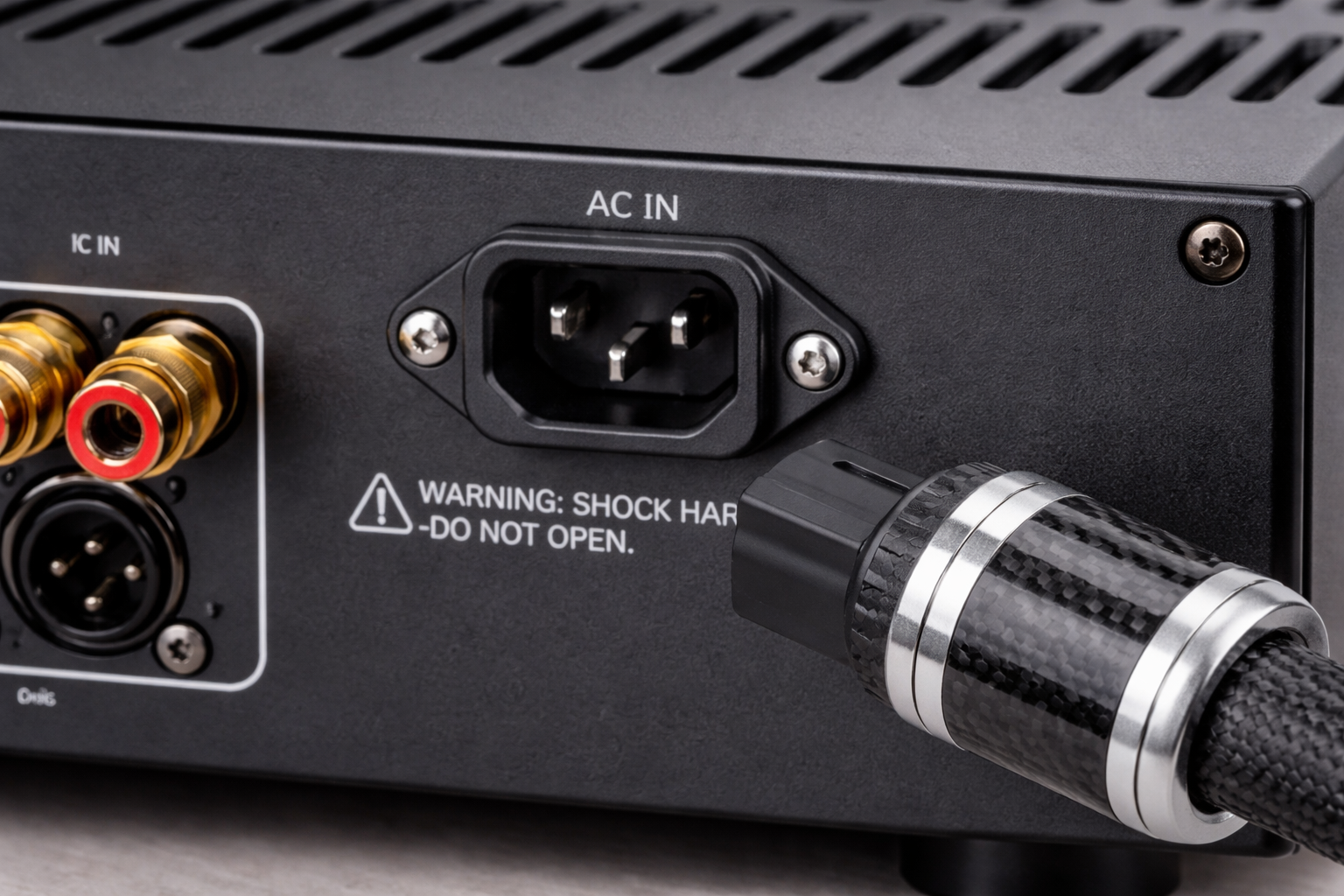
External View IEC Socket
The EIC socket installed in an amplifier is shown here:
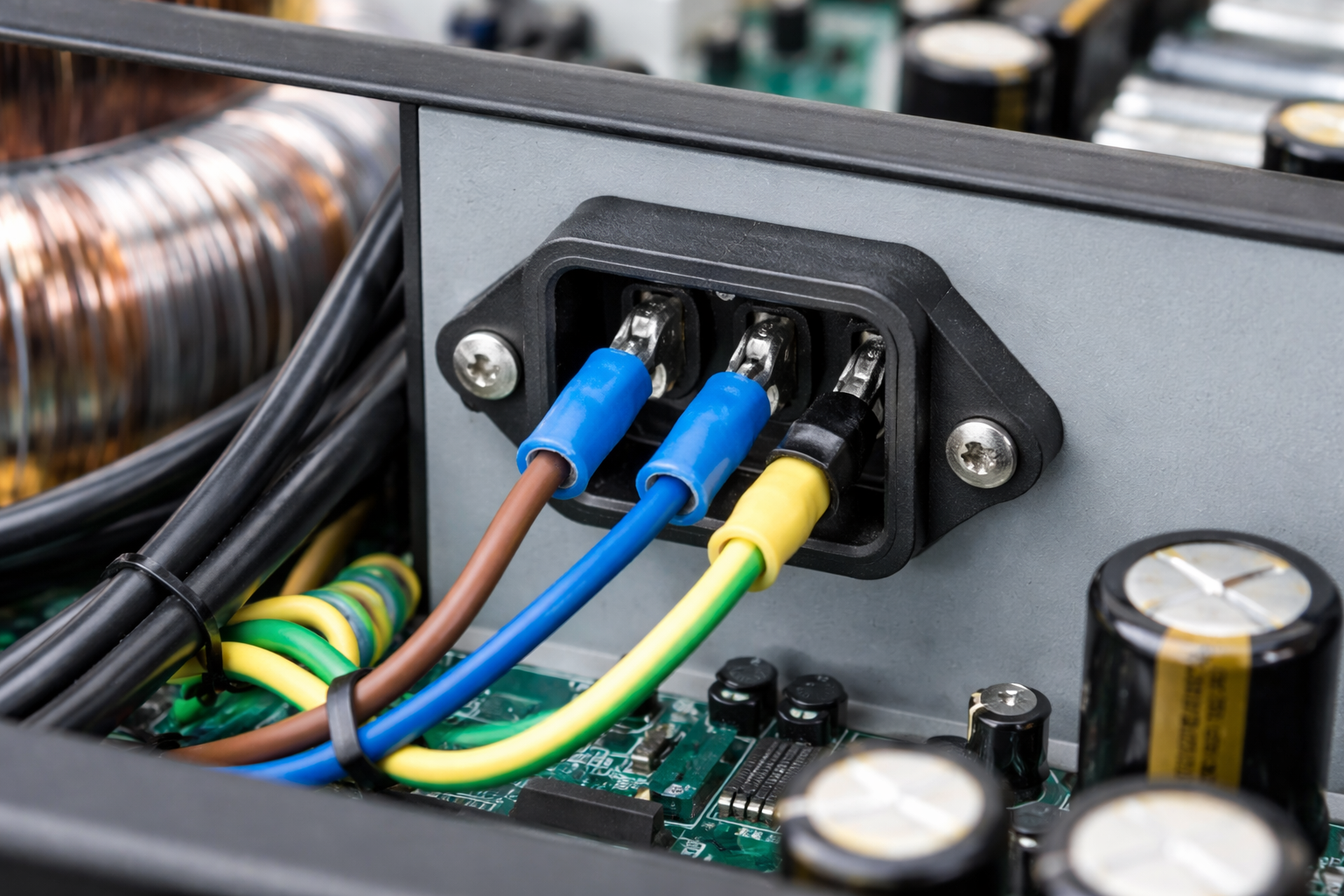
IEC Intstalled in an amplifer
Manufacturers fit IEC inlets during assembly by cutting a rectangular hole in the rear panel and securing the C14 socket with screws or snap-in tabs. The live, neutral, and earth terminals are then connected to the internal power circuitry—usually with quick-connect spade terminals in mass-produced gear, or soldered in higher-end models. The earth terminal is linked to the chassis, and strain relief prevents stress on the wires. This setup provides a safe, detachable interface and allows the same product to be shipped worldwide without region-specific plugs.
Inside an IEC connector are three main contacts—live, neutral, and earth—that bring mains power safely into the component. The live and neutral carry the electrical current, while the earth grounds the chassis to prevent shock and reduce noise. Spring contacts hold the power plug firmly in place, and protective plating on the metal surfaces helps prevent corrosion and maintain good conductivity. All of this sits inside an insulating housing that keeps the connections safe and stable, while mounting points secure the inlet to the rear panel. Terminals on the back connect the inlet to the component’s internal power supply, completing the path from the wall outlet to the electronics.
The Hidden Weak Link in the Power Path
Inside many audio components, the IEC inlet is a very inexpensive part. In large-scale manufacturing, it may cost only a few dollars. These connectors are typically made from moulded thermoplastic with basic stamped metal contacts. From an electrical perspective, they are perfectly functional. They meet safety standards, pass regulatory testing and deliver adequate current for the device. But from an audio reproduction perspective, they may have several limitations.
1. Contact Quality
Many stock IEC inlets use relatively thin brass contacts with minimal plating. Over time, these contacts can oxidise, increasing resistance at the point of contact. In a power system that feeds delicate analogue circuitry, small changes in contact resistance can theoretically influence the stability of the power supply.
2. Mechanical Grip
Another issue is the mechanical fit between the IEC socket and the cable plug. Cheaper connectors may grip the power cable loosely. Any microscopic movement in the connection can introduce small variations in contact pressure. High-end connectors attempt to provide stronger clamping force and tighter tolerances to ensure a stable electrical connection.
3. Materials and Plating
Standard connectors generally use nickel-plated brass. While durable, this material combination is not considered ideal for the lowest electrical resistance. Premium IEC connectors often use higher-conductivity materials such as pure copper or phosphor-bronze, sometimes plated with gold, silver, or rhodium. These materials resist corrosion and maintain lower resistance over time.
4. Vibration and Noise
Some manufacturers claim that higher-end connectors reduce micro-vibrations or electrical noise entering the chassis. Whether this is measurable or simply subjective is debated, but the design goal is clear: provide the cleanest possible interface between the mains supply and the equipment’s power supply.The
The Impact of Upgrading Cables but not the IEC
When audiophiles upgrade power cables, they improve the wiring from the wall to the equipment—but if that cable ends at a low-quality inlet, the final connection can become the weakest link. Think of it like a high-performance water pipe feeding a narrow valve: flow is limited by the tightest restriction. The IEC inlet is that restriction, where current leaves the cable and enters the component’s internal wiring. If its contacts are poor, even an expensive cable can’t deliver its full benefit.
High-End IEC Options
Several companies specialise in high-performance IEC connectors designed specifically for audiophile equipment, with Furutech and Oyaide among the most recognised. Furutech produces a wide range of upgraded inlets for high-end audio, featuring high-purity copper conductors, heavy gold or rhodium plating, non-magnetic stainless steel hardware, advanced insulating materials, and very tight mechanical tolerances. Retail prices typically range from $80 to $250 USD (roughly $120–$380 AUD), with some flagship models exceeding this.
Oyaide is another highly respected Japanese manufacturer. Their IEC connectors often use precision-machined phosphor bronze contacts, thick silver or gold plating, high-temperature polymer housings, and carefully engineered contact pressure to ensure a secure, low-resistance connection. Prices generally range from $70 to $200 USD. While these connectors cost significantly more than standard inlets, they remain relatively affordable compared with high-end power cables and are regarded by many audiophiles as a cost-effective way to improve system performance.
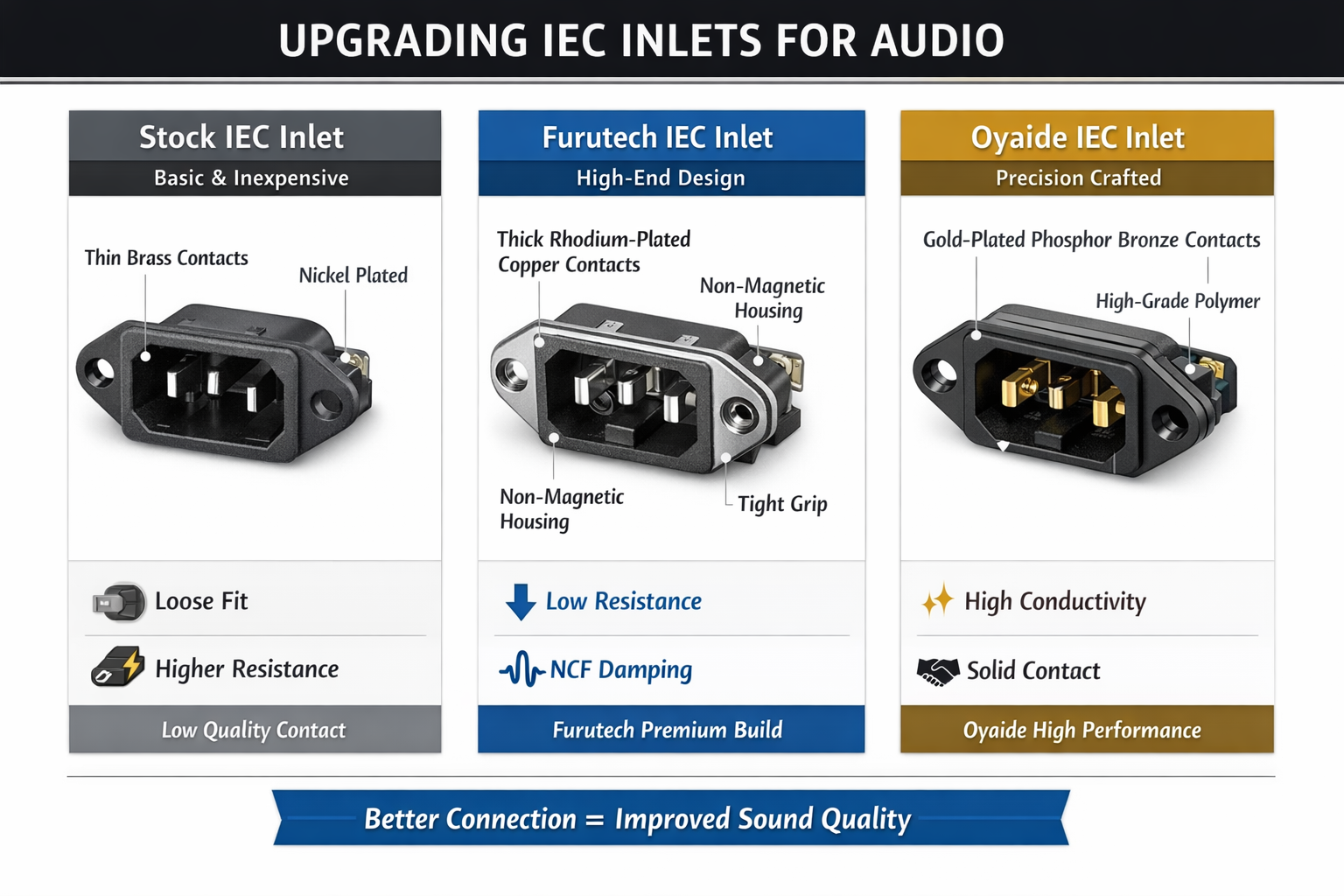
Upgrade Summary
Enhanced IEC inlets for audio systems range widely in materials, build quality, and price. Entry-level units, often $3–$20, use basic copper with simple housings, while mid-range options ($70–$200) feature thicker gold or rhodium plating, robust metal bodies, and tighter tolerances. High-end connectors, such as Furutech’s flagship models, can cost $400–$600 and incorporate exotic alloys, advanced insulating materials, and vibration-damping elements. Across the range, differences in conductivity, mechanical stability, and finishing quality reflect the potential impact on system performance, making the choice of inlet an important consideration for audiophiles.
Use of fixed Chords
Some manufacturers still take a different approach. A handful of brands wire their components directly, eliminating the detachable IEC entirely. The idea is simple: by controlling the power cable, the designer ensures the equipment performs exactly as intended. There’s only one interface, no potential weak link at the socket. Theoretically, this can slightly reduce resistance and preserve the designer’s voicing. But it comes with a downside. Fixed cables tie the owner to a specific length and plug type, making it harder to adapt to different homes, power outlets, or cable preferences. That’s why the detachable IEC remains the standard—it offers flexibility without compromising safety, allowing owners to select cable length, experiment with upgrades, or simply replace a worn cord.