

Part 1: Power Cables and the Character of Sound
Every audio component relies on the quality and stability of its power source. The power cable forms the crucial link between the mains supply and the internal power supply of an amplifier, digital player, turntable motor, or other device. Its design shapes the electrical environment in which the equipment operates.
An enhanced power cable is more than a visual update. Its design involves choices about conductor thickness, metal type, insulation, internal geometry, and connector design. These decisions affect properties such as resistance, impedance, and susceptibility to electrical noise. For example, a cable with thicker conductors and enhanced shielding can minimise unwanted electrical noise. This promotes more consistent voltage delivery to an amplifier and influences the internal power supply’s behaviours. While these effects are usually subtle, they can result in greater clarity, stability, and perceived dynamics in sensitive systems.
A key aspect of cable design is conductor size. Electrical wire is rated using the American Wire Gauge (AWG) system; lower AWG numbers indicate thicker wires. Thickness is important because it influences resistance, which opposes current flow, leading to minimal energy loss as heat and a slight voltage drop along the cable. This becomes relevant when audio equipment demands significant current. Power amplifiers, especially class-A or high-power class-AB designs, require sudden current bursts during musical peaks. Thin cables with higher resistance may restrict this flow, similar to water moving through a narrow pipe. Thicker cables present a lower-resistance path, enabling freer current movement. This can result in greater ease during dynamic passages, with the system sounding less constrained. As a result, many enhanced power cables use heavier conductors than standard options.
The conductor’s metal is also significant. Copper is the standard owing to its high conductivity, flexibility, and reasonable cost. Higher-quality cables often use copper refined to remove oxygen and impurities—oxygen-free copper has a more uniform structure and slightly lower resistance.
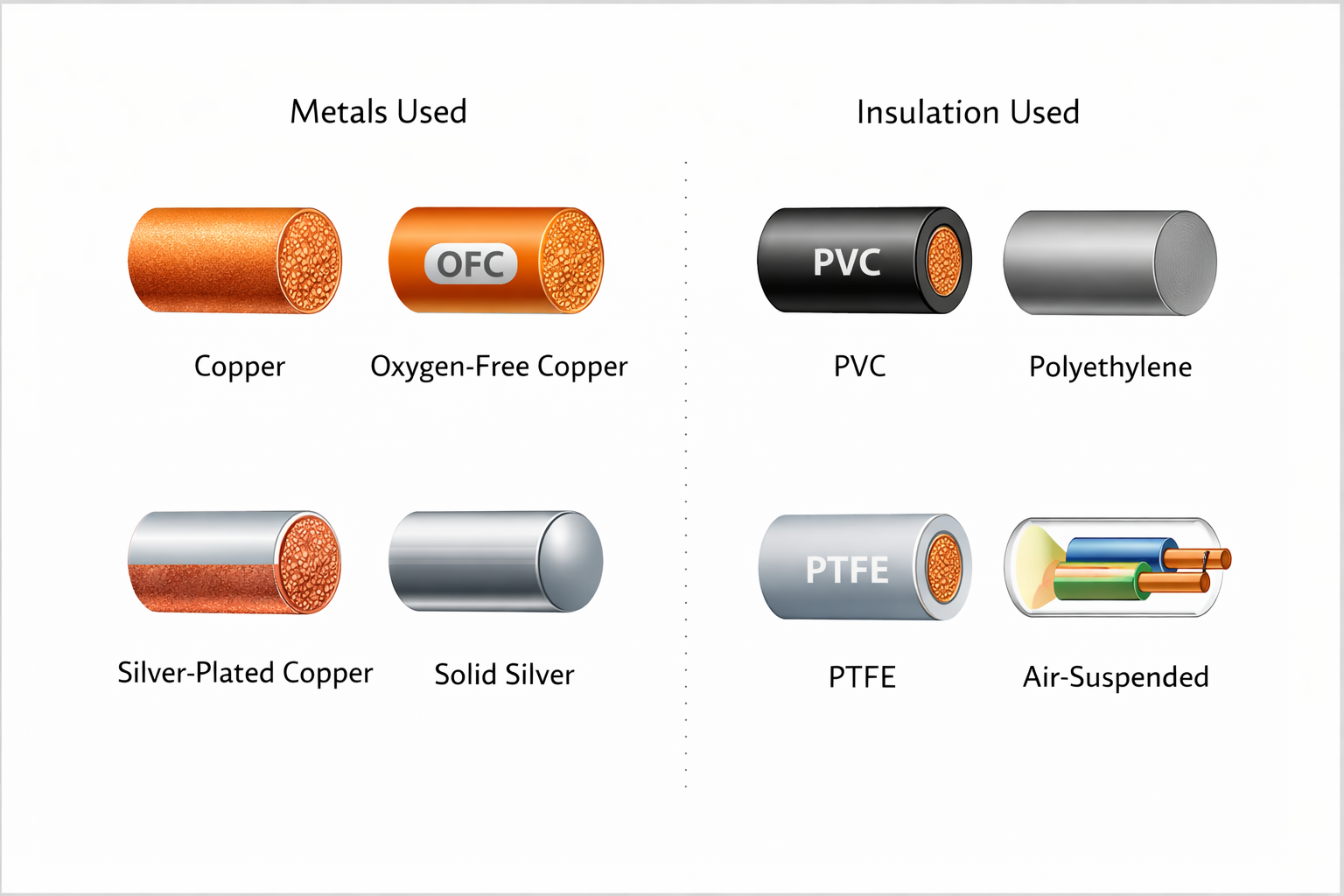
Power Cable Metals
Some cables use copper conductors plated with silver. Silver is the most conductive metal used in wiring. The advantage of silver plating lies in its surface properties. It forms a stable, conductive interface at the connector, helping maintain consistent contact over time. A few specialised cables use solid silver conductors, but their cost limits this approach to premium products.
The manufacturing process also influences the wire’s structure. Electrical wire is made by drawing a metal rod through a series of progressively smaller dies. This shapes the metal’s internal crystal structure, forming microscopic grain boundaries where crystals meet. These boundaries do not block current but can slightly increase resistance and serve as sites where oxidation may occur.
Some manufacturers aim to reduce these boundaries through advanced casting and drawing. Techniques like continuous casting yield longer crystal structures, sometimes called long-grain metal. The goal is a more consistent conductor with fewer interruptions. The electrical differences are minor and often debated, but these methods may enhance durability and corrosion resistance.
Surrounding the conductor is the insulation, or dielectric. Its primary role is to prevent electrical contact between conductors, but it also influences electrical behaviours. All insulating materials store and release small amounts of energy as voltage varies. This is known as dielectric absorption.
Many standard cables use polyvinyl chloride (PVC), which is both affordable and flexible. However, PVC tends to exhibit relatively high dielectric losses. Alternatives such as polyethene and polypropylene offer lower dielectric constants and interact less with the electrical field surrounding the conductor. Some cables instead use polytetrafluoroethylene, commonly known as Teflon, which possesses very low dielectric absorption and high stability. Because Teflon stores less energy, the electrical field around the conductor can respond more freely as current flows through it. Some designs advance this approach further by introducing air gaps or suspending the conductor within tubes. Air is a particularly effective dielectric, introducing almost no electrical interaction.
The physical arrangement of conductors inside the cable also matters. In basic designs, conductors run parallel to each other. More advanced cables twist the conductors or arrange them in specific geometries. Twisting helps reduce electromagnetic interference by allowing the effects of external fields, which can induce small, unwanted signals, to cancel each other out. One notable configuration is the star-quad geometry, in which four conductors are arranged around a central axis. In this design, opposing conductors carry the same polarity, enhancing symmetry and reducing susceptibility to noise. Some cables also include an outer shield made from braided copper or metallic foil, which acts as a barrier against radio-frequency interference.
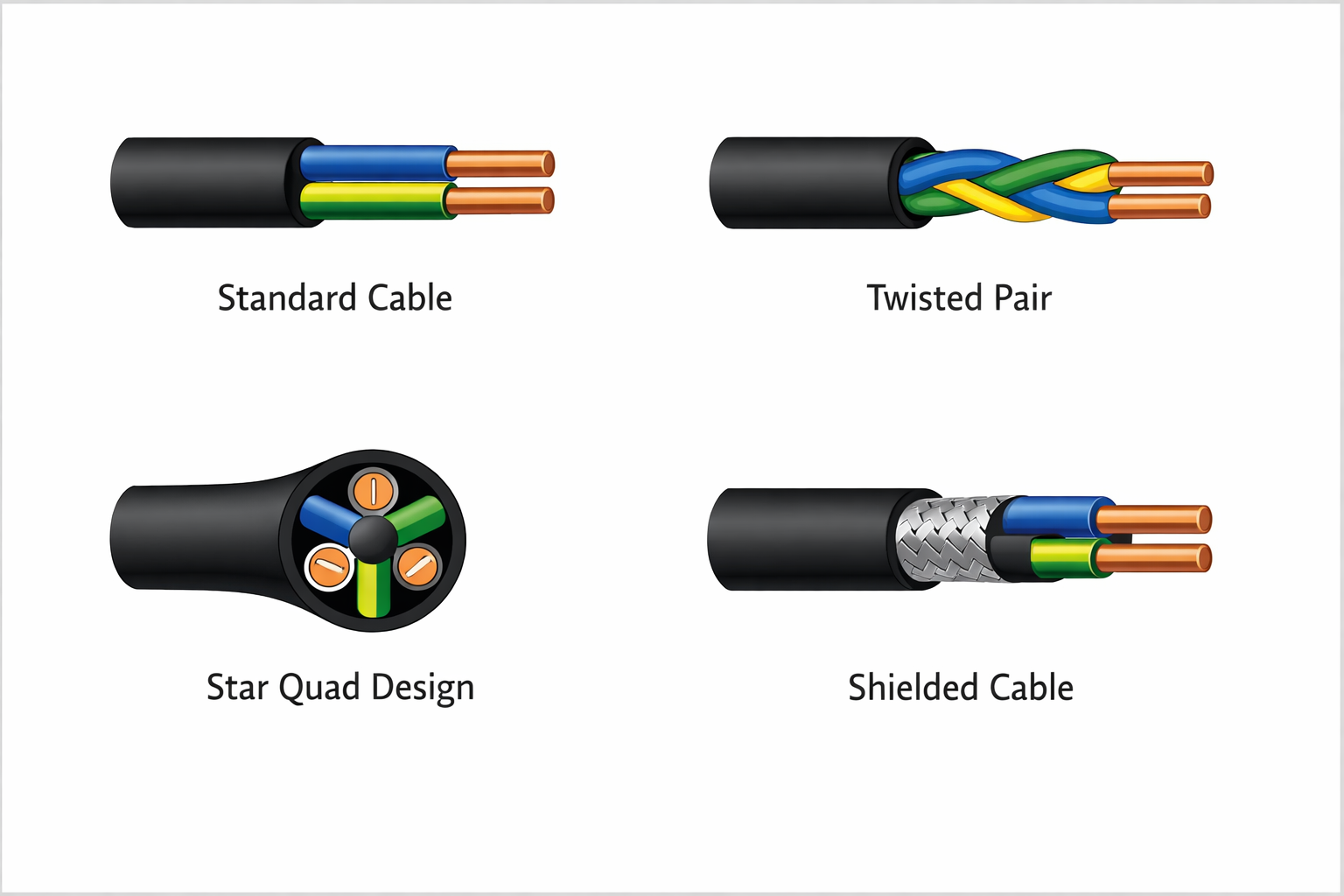
Cable methods
The connectors at each end are as vital as the cable itself. A plug must deliver a secure mechanical and electrical bond to both the wall socket and the equipment. Loose or uneven contact increases resistance at the joint. Even minor contact resistance creates heat and disrupts stability.
Enhanced connectors use precisely machined contacts and strong spring pressure to ensure secure engagement. The contact surfaces are often plated with corrosion-resistant materials. Gold is widely used because it does not oxidise, helping to maintain a stable interface over time. The thickness of this plating is also important. If it is too thin, it can wear away with repeated use, exposing the base metal.
Corrosion resistance is important because audio systems are often left connected for extended periods. Over time, oxidation can increase resistance and cause instability. In more severe cases, this may lead to intermittent noise or brief interruptions. Well-designed connectors help avoid these issues. Cable length is another important consideration. As length increases, so does total resistance. In most systems, the difference between a 1-metre and a 2-metre cable is minimal, but very long cables can cause noticeable voltage drops, especially when thinner conductors are used.
Longer cables also have higher inductance and capacitance. These properties describe how the cable responds to changes in current and field. While effects are modest at mains frequencies, they can influence how high-frequency noise travels. For this reason, keeping cables short is often advisable. There are exceptions. Some designs, such as those from Van den Hul, can provide greater noise reduction over slightly longer lengths.
Although noise reduction is often emphasised, the influence of a power cable can extend beyond this effect. As part of the power-supply path to an audio component, a cable with lower resistance, better shielding, and more stable connections can help the internal power supply operate more consistently. When the power supply is stable and relatively free from interference, small improvements in sound quality may occur. Listeners sometimes describe a quieter background, where silence feels more settled and less granular. Low-level details become clearer, and dynamic shifts occur more naturally rather than feeling forced. In some systems, there may also be subtle changes in tonal balance or spatial presentation. While these effects are generally modest and dependent on the specific system, over time, they can influence how naturally music is perceived.
Differences among cables from Oyaide, Van den Hul, and Furutech reflect their respective design philosophies. Oyaide emphasises highly refined copper, precision machining, and controlled plating thickness. Furutech prioritises contact quality and metallurgical treatment, including cryogenic processing and demagnetisation. Van den Hul uses hybrid conductors and intricate structures to manage noise and mechanical traits. These strategies alter resistance, inductance, capacitance, and shielding, explaining why various cables deliver distinct sonic results.
Practical considerations also matter. Cables with thick conductors and heavy shielding can become stiff and difficult to position. Excessive rigidity may strain equipment sockets. Many designs use multi-strand conductors to improve flexibility while maintaining performance.
Cost remains one of the most debated aspects of enhanced power cables. Prices range from modest upgrades to products costing hundreds or thousands. These costs reflect material quality, manufacturing complexity, connector design, and assembly precision. Improvements often exhibit diminishing returns. Swapping a thin, poorly manufactured cable for a well-built, heavier-gauge one can provide notable advantages. However, beyond that, further improvements tend to be smaller and more dependent on the overall system. A highly resolving system might show small additional improvements, whereas a more basic setup might not.
Ultimately, the function of a power cable is straightforward. It supplies a stable, low-impedance connection between the mains and the audio component. By controlling conductor size, material quality, insulation, shape, and connection reliability, designers aim to minimise losses and interference. The audible differences may be subtle, but they can add up. In a system capable of capturing fine nuances, these small improvements help create a sense of presence, flow, and coherence that makes reproduced music feel less like a signal and more like a live performance