

Part 2: Breaking the Binary: What Holmes & Watson Would Say
An account of Sherlock Holmes and Dr Watson can illuminate the audio divide in a novel way. Holmes and Watson embody different relationships to sound and listening. Holmes represents disciplined reason. For him, clarity of perception is the foundation of understanding. Yet even Holmes cannot encompass the full range of human experience. That is where Watson enters, a counterweight to Holmes’s methodical mind. Together, they show that rigorous observation and human engagement must converge.
The Tribal Divide in Audio
This balance is almost absent in audio forums. The mildest question can erupt into a flame war. Positions harden: Blu-ray versus DVD, analogue versus digital, cables defended with zeal. Debate collapses into jargon: “warmth,” “air,” “soundstage” are often used to signal allegiance rather than to persuade.
Rarely does anyone interrogate assumptions beneath these claims. Conviction is mistaken for evidence, plausibility for proof. Holmes would see the danger instantly: the greatest obstacle to truth is prejudice masquerading as knowledge.
To assess music reproduction, we must cultivate Holmes’s discipline: the courage to scrutinise devices and convictions alike.
A Dialogue on Listening and Exercising Judgement
One can imagine a discussion between Holmes and Watson in their Baker Street rooms:
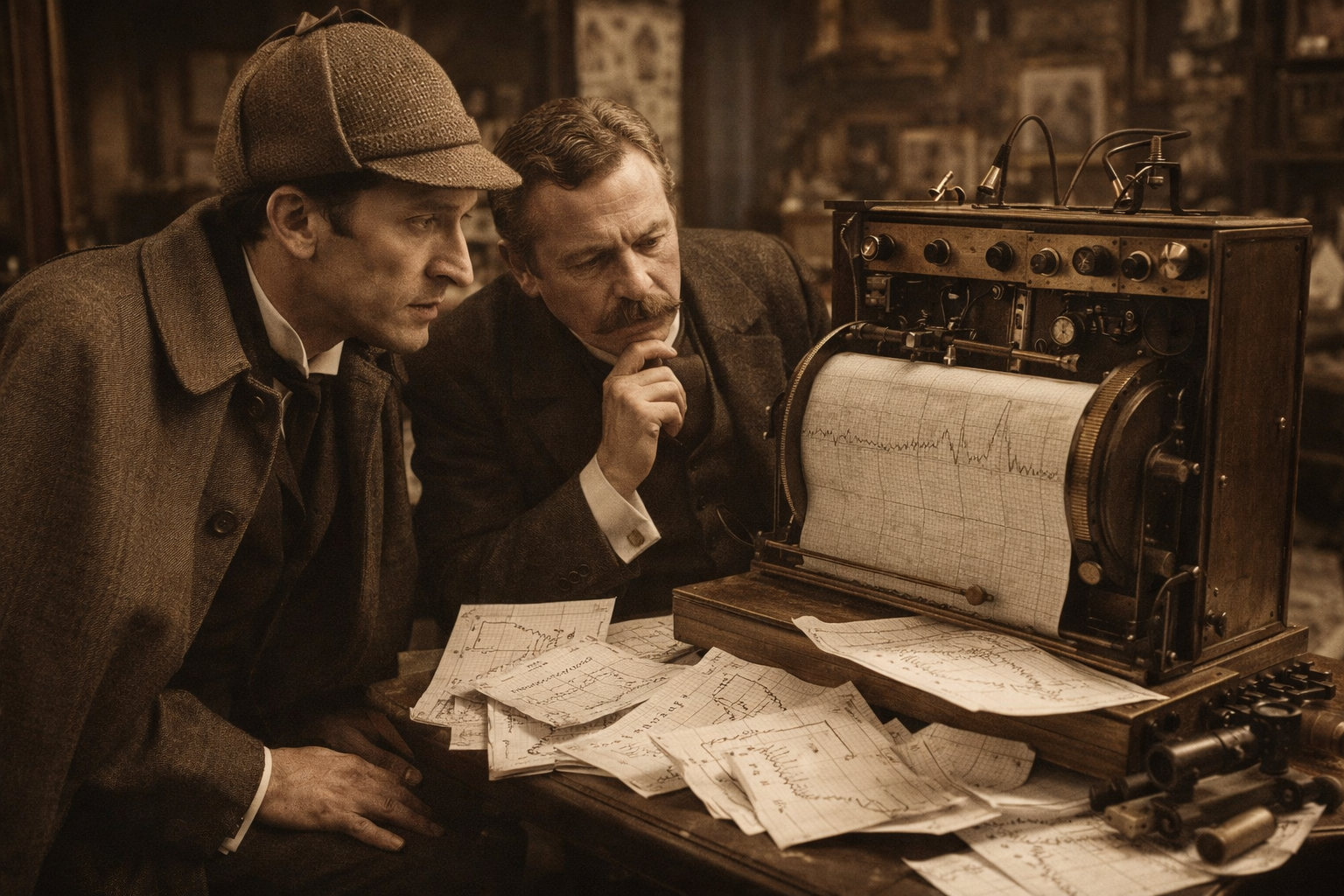
Holmes and Wason Evaluating Frequency Response
Watson: Good heavens, Holmes, what contraption is this? It seems more suited to the Royal Institution than our sitting room.
Holmes: An Audio Precision analyser, Watson, a detective in its own right, able to evaluate an amplifier’s performance.
Watson peers over sheets of waveforms.
Watson: Surely, Holmes, these lines cannot reveal how the amplifier sounds.
Holmes: On the contrary. The instrument hears much. It captures the amplifier’s sound, but the challenge is presenting the data in a form we can interpret. Simple waveforms simplify what we see—not due to the machine, but to the limits of our perception.
Testing an amplifier is not merely diagnostic; it is formative. It demands intellect, intuition, and something near the spiritual—burning bright in some, flickering in others. Experience may refine it, but raw faculties must be present. One engineer may conjure sound that stirs the soul; another produces mediocrity—or worse.
Raw perception combined with experience is essential to understanding sound.
The Subtleties of Audio
Consider subtleties beyond obvious distortions. A dusty stylus or a clipping amplifier is easy to detect. Beyond them lies the fabric of noise, the space in which the performer is heard.
Science may dismiss it, but the listener perceives meaning—the imprint of walls, floor, and audience. Strip it away, and you erase whether music was born in a studio or a hall.
Holmes: Consider crossover distortion in a poorly biased transistor. A subtle imperfection near zero crossing produces a kink in an otherwise smooth waveform. Small deviations may seem inaudible, but can produce treble like “smashed glass.” In contrast, triodes offer smooth, silky treble.
Watson: Music is no sine wave. At a concert, I hear the instrument, the hall, and the audience. How is this richness captured here?
Holmes: The ear constructs space from faint clues. A photograph is made of grains, yet we see a face. So with hearing, an FFT shows harmonics, but the ear perceives presence.
Numbers alone do not convey the soul of music; listening and interpretation complete the picture.
Reason Meets Resonance
Watson: Then I provide the resonance, Holmes, while you supply the evidence. Together, we weigh and feel in equal measure.
Holmes: Precisely. Alone, I risk reducing music to hieroglyphs; you risk mistaking illusion for truth. Together, reason and resonance grasp not just sound but the life and soul in each tone.
True fidelity combines evidence and human empathy—reason and resonance together.
The Limits of Metrics
Watson: I am still befuddled about what figures tell us about music reproduction.
Holmes: Figures are the skeleton; you must see how the bones move before the creature comes alive. Frequency response: if the upper range is curtailed, a voice sounds thin and metallic. If the curve dips near 100 Hz, the bass loses foundation. Alter the curve, and the sound itself changes.
Watson: And a mere decibel makes a difference?
Holmes: Absolutely! Music is a crowded parlour where instruments jostle for space. Raise the volume a decibel, it stands proud; cut the guitars, and you clear a path—the art of unmasking.
Small adjustments can have profound perceptual effects. Listening must guide measurement.
Phase, Transients, and Truth
Phase shifts, crossovers, and digital EQ introduce subtle time differences. Left and right channels may drift; transient response may smear. Even a device with a flat frequency graph may sound very different from another.
Faithful reproduction depends on timing, transients, and harmonic relationships—not just measured specs.
Dogma vs Listening
Holmes warns that designers who insist that only their circuit conveys truth replace perception with dogma. Confidence is cheap; the rare skill is listening with humility. Improving one parameter can worsen another; expensive parts do not guarantee fidelity.
Open-minded listening, not allegiance to technology, is the true measure of fidelity.
The goal is neither tubes nor transistors, Class-A nor Class-D. True fidelity owes allegiance only to the music. Anything else is ego, not engineering. The open ear is the ultimate test of sound.
Insights:
Prejudice masquerading as knowledge is the biggest obstacle to truth.
Numbers and measurements alone cannot capture the soul of music.
True fidelity requires the balance of reason (Holmes) and resonance/empathy (Watson).
Even small adjustments in frequency, phase, or transient response can dramatically change perception.
Dogma is the enemy of listening; humility and curiosity are essential.