

Part 3: Breaking the Binary: Audio Note’s Hybrid Design Explained
Recognising the importance of subjective listening in music appreciation does not reduce the role of objective measurement. Quantitative analysis remains key to identifying distortions, frequency imbalances, nonlinearities, and other technical issues that listeners might miss. These problems affect long-term performance, listening fatigue, and overall sound quality.
Precise instruments such as Audio Precision analysers reveal subtle issues, including jitter, phase irregularities, and weak power-supply regulation. Listeners often notice these problems as tonal strain or gradual fatigue—effects that appear over extended listening and quietly reduce engagement.
Objective measurement provides a solid foundation for audio design. By checking electrical and acoustic behaviour, manufacturers reduce variability and maintain consistent production. Measurement, therefore, supports listening rather than opposes it. Together, they form a complete approach that balances technical accuracy with human perception.
High-quality headphones or loudspeakers show details that might otherwise stay hidden. Yet instruments alone cannot capture what moves us in music. Listening involves both thought and feeling. When careful measurement pairs with attentive listening, engagement with sound becomes richer and more reflective.
Audio Note’s Design Philosophy
Audio Note (UK), often called subjectivist, actually presents a balanced position:
“A holistic approach to audio design, bridging the traditional divide between subjective listening and objective measurement.”
The company questions the idea that sound reproduction can rely only on metrics. Listening serves as the final judge because musical perception involves emotional and hearing-related factors that measurements cannot fully capture. Qvortrup notes that instruments cannot capture every nuance or emotional response. Materials, layout, components, and wiring influence perceived sound in ways that standard data may miss.
Qvortrup summarises this view:
“Good audio design is both science and art; it’s the meeting place where numbers and feelings coexist.”
Andy Grove, Audio Note’s lead engineer, treats audio reproduction as a human, hands-on process rather than a purely technical one. Music unfolds through time and space, and playback systems must preserve this flow to sound convincing. Engineers aim not for perfect test signals or very low distortion alone, but for equipment that conveys tone colour, spatial relationships, phrasing, and dynamic contrast naturally.
Going Beyond the Graph
Much of the audio industry focuses on sound performance—flat frequency response, low distortion, and low noise. These goals remain valid. Distortion and bandwidth limits can weaken a signal and need to be addressed. For Grove, they remain necessary but not sufficient.
Modern measurement tools describe impulse response, phase behaviour, and group delay. Yet these numbers do not reliably predict how listeners perceive timing and spatial cues over long sessions. A system can measure well while temporal or spatial coherence suffers. Music can sound clean but lifeless.
High feedback ratios, multi-stage circuits, or phase-altering filters can weaken timing cues even when distortion figures look excellent. Research on group-delay audibility shows that listeners detect these effects despite a flat frequency response. Distortion rarely appears obvious. Rhythm loses drive, attacks soften, and decay becomes less expressive. Listeners feel disengaged rather than noticing a technical fault.
Music must maintain motion and presence. Percussion should arrive with immediacy. Bass lines should breathe. Harmonics should bloom and fade naturally. When timing or spatial cues blur, the system changes more than the signal—it weakens the listener’s connection. Fidelity begins not at the edge of a graph but in keeping time and space intact.
“Clear timing, dynamics, and spatial cues let listeners experience not just sound, but the musical event itself.”
Measurement, Listening, and Material Voicing
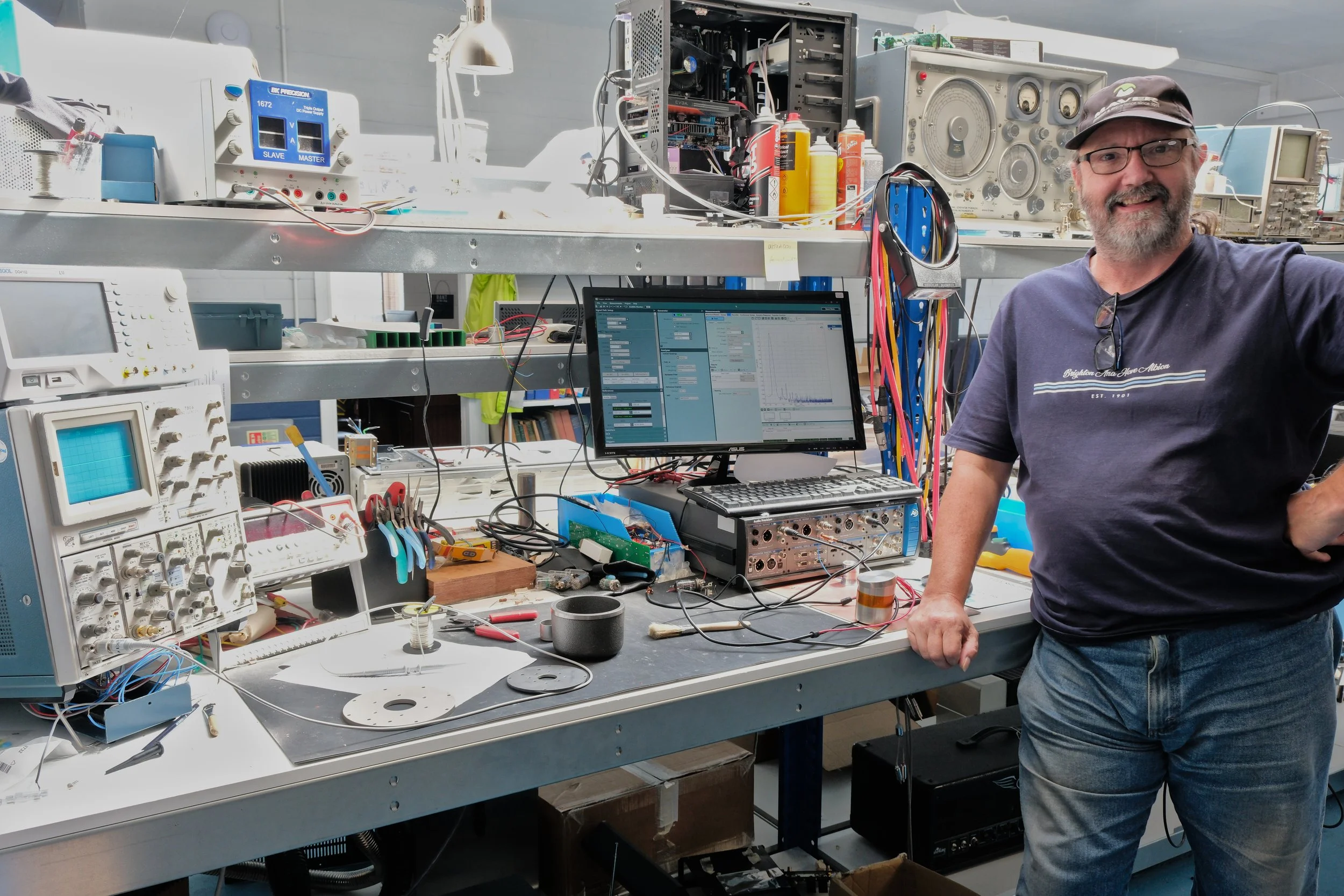
Andy Grove and Test Equipment
Audio Note takes a balanced approach. Measurement provides key insight, yet critical listening ultimately guides decisions. Engineers use data to guide circuit design and component selection, then refine the design through long listening. Some components are chosen not only for their electrical properties but also for how they work in the circuit—effects that measurements cannot always capture.
Grove calls this “material voicing.” It shapes character by showing how materials and construction affect perception. Some differences fall below the resolution of tests, yet listeners notice them over time through harmonic decay, transient integrity, and phase coherence. Measurement shows part of the influence; listening completes it.
Design proceeds step by step. Measurement informs construction. Listening yields results. Engineers then revise. They do not ignore metrics but recognise their limits and add careful auditory evaluation. The tension lies not between measurement and listening, but between what measurements capture and what listeners notice as decisive.
Design Choices and the Collapse of a False Binary
Audio Note’s balanced approach underpins some of its most debated design choices. Non-oversampling DACs and valve-rectified power supplies may seem unusual from a measurement-first perspective, yet they preserve phrasing, flow, and timing. Certain digital filters can introduce time-domain artefacts that listeners notice more than small frequency issues. Valve rectification lets dynamics unfold naturally, giving music the relaxed tension of a live performance.
Strict measurement purists may see these practices as romantic; idealist subjectivists may see them as disciplined. Audio Note deliberately collapses this binary, fusing empirical method with musical intuition. The company focuses not on technical perfection alone but on fidelity to the music.
For Grove, audio design presents a perceptual challenge: how to make a listener feel the presence of real musicians in the room? Quality audio reproduction persuades, making listeners forget the equipment and inhabit the music. Fidelity combines objective precision with perceptual insight, creating an immersive, responsive, and musically convincing experience.
Insights
Measurement and listening show different truths.
Instruments have limits.
Listening shows musical meanings.
Flat graphs do not guarantee musical life.
Timing, space, and flow determine vitality. •
Time matters as much as tone.
Design choices are never neutral.
Every circuit favours certain perceptions.
A hybrid approach is discipline, not compromise.
Measurement sets limits; listening sets priorities. •
Fidelity serves music. The goal is to create a convincing presence for a musical event.