

The Hidden Choices That Shape Loudspeaker Sound
Loudspeaker manufacturers often portray design choices as simple and purely engineering-driven. This is seen in brochures, presentations, and online reviews. However, beneath these confident claims lies a more complex truth. Every feature is the result of negotiation between technical possibilities and practical limitations. Each decision involves careful trade-offs, not just straightforward progress.
This article argues that such compromises, especially in crossover networks, fundamentally shape loudspeaker performance. First, it examines how engineering limits and economic factors create competing priorities. Next, it explores how hidden crossover choices influence the audible result. Finally, it considers how these trade-offs affect both production and the listener’s experience. Understanding these complexities deepens appreciation for loudspeaker sound and technological design.
Design Reality
The manufacturers' explanations about their loudspeaker designs are not false. But they are often incomplete. Engineering is full of compromise. Marketing, on the other hand, is allergic to it.
The result is that many of the official explanations for why speakers are designed the way they are sound cleaner than reality.
Behind the tidy narrative lies a more complicated reality. Loudspeaker design is an exercise in compromise. Physics sets limits. Economics imposes constraints. Designers must balance competing priorities. What reaches the listener is the result of many careful trade-offs.
A loudspeaker attempts to recreate a complex acoustic event with few tools. A string quartet fills a room with harmonics, timing cues, and reflections. The instruments interact with each other and with the space around them. A stereo system tries to reproduce the same scene using only two loudspeakers. Remarkably, our brains can fill in missing information. We perceive a believable musical space.
Yet this simplification shows how fragile the process is. Designers often have to choose between accurate frequency reproduction and high output. The intended use of the loudspeaker guides which aspect is prioritised.
The Hidden Network Inside the Speaker
Most people imagine a loudspeaker as a set of drivers in a cabinet: a large one for bass, a small one for treble, and sometimes another for midrange.
Hidden inside is a small electrical system called the crossover. It divides the amplifier’s full-range signal and sends the correct frequencies to each driver.
In theory, the idea is simple. A capacitor blocks low frequencies and lets high ones pass. An inductor blocks high frequencies and lets low ones pass. Together, they split the signal. In practice, the boundaries are rarely neat.
As engineer Douglas Self observes:
“Real crossovers don’t behave predictably; they don’t follow textbook principles.” Drivers add complexity. Their electrical impedance fluctuates. Cones resonate. Outputs overlap.”
The crossover must do more than split frequencies. It compensates for these behaviours. This allows multiple drivers to work together as a coherent acoustic source. The crossover is where many design compromises are negotiated.
Steep Crossover Slopes
Modern loudspeakers often rely on steep crossover slopes. Instead of gently reducing frequencies outside a driver’s range, these filters cut them off aggressively. Some reach 24 decibels per octave. A decibel measures sound level. An octave represents doubling or halving of frequency. A 24-decibel slope reduces unwanted frequencies four times faster than a simple first-order network.
The logic is straightforward. Drivers perform optimally within certain ranges. Tweeters can be damaged by low frequencies. Woofers often distort at high frequencies due to cone flexing. Limiting each driver to a narrow band reduces distortion.
In engineering presentations, steep crossovers often appear as a form of excellence. They suggest driver control.
There is nothing wrong with this approach. But many overlook how these slopes are achieved. Open a loudspeaker with a complex crossover, and you will find a crowded circuit board. Coils, capacitors, and resistors all fine-tune driver behaviour. Together, they shape the signal before it reaches the drivers.
But there is a trade-off.
The Signal Path
“Every crossover component sits in the path of the music.”
Inductors introduce resistance and magnetic effects. Capacitors store and release energy. Resistors convert part of the signal into heat. Each component makes small changes. Yet as the signal passes through multiple elements, these changes accumulate. In isolation, these effects are tiny. Electrical engineers measure them in fractions of an ohm or minute shifts in phase. But audio signals are fragile things. When several components are in series with the signal, the cumulative effect becomes significant. It is a little like asking a message to pass through ten people before reaching its destination. Each person repeats it, but by the time it arrives, it may not sound quite the same as when it started.
Complex networks can introduce phase shifts. Different frequencies are delayed by varying amounts. This can disrupt timing between drivers. Sounds from the woofer and tweeter may reach the listener slightly out of sync. Sharp transients—plucked strings, drum hits—can become blurred. Resistance may reduce signal transfer efficiency. These small alterations subtly affect frequency response and dynamic range.
Each added component shapes the output. It also introduces unintended effects. This illustrates the compromises inherent in loudspeaker design. What looks like a simple filter is actually a delicate balance between control and simplicity.
The Question of Components
If a crossover has many parts, quality becomes even more important. See the original crossover in the Tannoy Westminster Royal. Jeff’s Place.
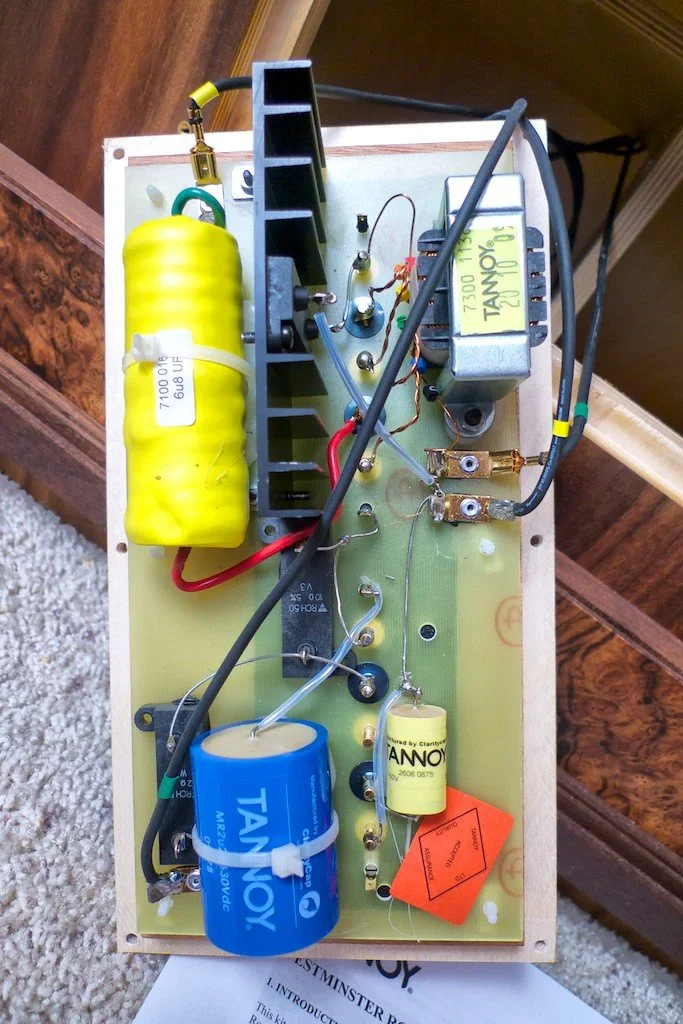
High-quality inductors use thick copper wire and air cores to reduce resistance. Film capacitors offer stable performance. Precision resistors keep their values consistent under heat. All are available, but they increase cost, weight, and size.
In theory, designers could populate the network with the finest components available—massive air-core inductors, extremely high-grade film capacitors, precision resistors built to laboratory standards. But loudspeakers are products that must be manufactured and sold. Every component carries a cost, and as crossover networks grow in complexity, those costs multiply quickly.
Premium inductors can be large. High-quality capacitors are costly. High Quality Complex crossovers raise a speaker’s price and bulk. Manufacturers must balance performance with practicality. Reliability, cost, manufacturability, and performance all need to be considered. Consider the high-quality replacement crossover discussed at Jeff’s Place.
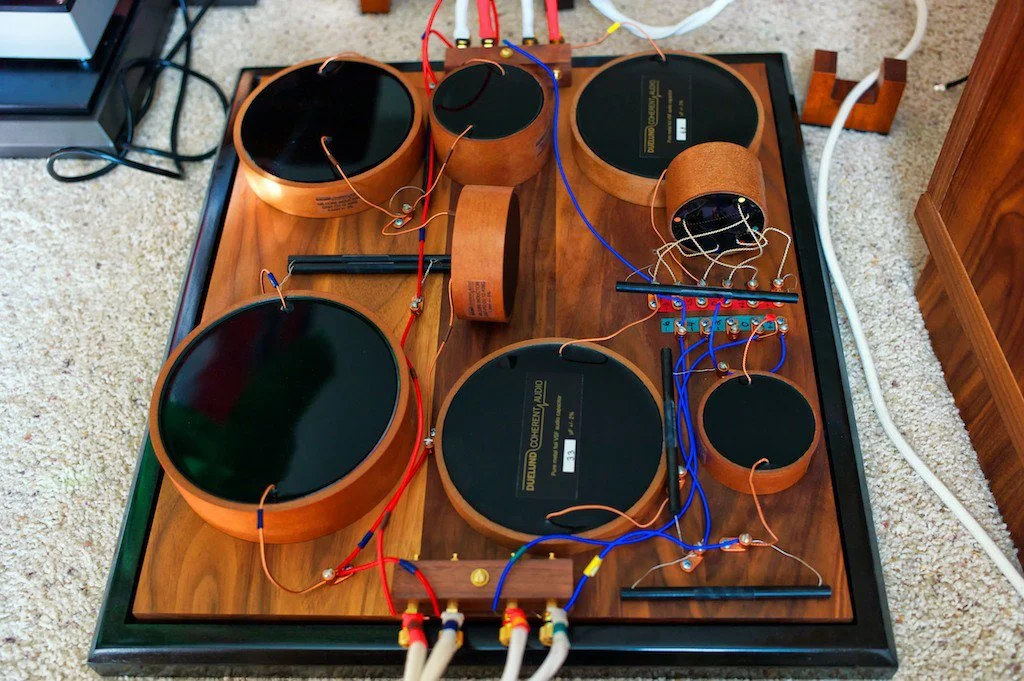
Some might assume that modern loudspeakers avoid mid- or lower-quality crossover components. Extensive testing by GR Research tells a different story. Across a wide range of speakers—including more costly models—they found a surprisingly high incidence of mid- to low-grade parts used in crossover networks. The findings make it clear that even in expensive designs, practical and economic compromises often dictate component choice.
“A loudspeaker is never perfect. It is a set of deliberate compromises.”
Measurement and Its Limits
Modern design relies heavily on measurement. Frequency response graphs, distortion plots, and dispersion maps allow precise analysis. Over time, these tools have improved consistency. Yet measurement has limits. Some aspects of sound—spatial cues, microdynamics, timing—are hard to capture in charts. A frequency graph shows tone balance. But it cannot show a vocalist’s apparent location or the shimmer of a plucked string.
Graphs also influence marketing. Steep crossover networks produce impressive curves. Presented graphically, these results tell a compelling story. Yet they rarely reveal the compromises behind them.
Steep crossovers are also attractive for production. If a tweeter only needs to operate above 3 kHz, its design becomes simpler. A midrange driver intended for a narrow band can be optimised more easily. This assists manufacturers in sourcing drivers and maintaining consistency.
None of this is deceptive. It reflects real constraints. Focusing only on “perfect sound” can obscure these practical realities.
First-Order Crossovers
Not every designer favours complexity. Some prefer simplicity. First-order crossovers use only 6 dB/octave slopes. In their simplest form, the tweeter passes through a single capacitor. The woofer passes through a single inductor. The network may have only two components.
To engineers used to complex filters, this seems primitive. Critics say drivers may reproduce frequencies outside their ideal range. This can increase distortion, reduce power handling, and limit volume. All of this is true.
Advocates value simplicity. Fewer components mean the signal is less altered. Many listeners report that simple crossovers sound more immediate, open, and natural.
Perception is subjective. Preferences, experience, and context all matter. Cognitive biases can influence perceived differences. Measurements do not always match listening impressions. Simplicity carries risks. Drivers may operate beyond optimal ranges. Output may be limited. Designers must weigh compromises carefully.
A Question of Philosophy
Debates between complex and simple crossovers rarely resolve. They reflect different priorities. Some value precise control and strong measurements. Others prioritise signal simplicity and musical nuance. Each loudspeaker embodies a philosophy. Choices—crossover slopes, component count, part selection—reflect designer judgement.
Recognising this does not diminish achievement. It shows that negotiation of trade-offs is central to technological progress. Designers balance constraints, creativity, and innovation. Loudspeaker design illustrates how thoughtful compromises can produce results that surpass individual limitations.
Despite imperfect drivers, filters, economic constraints, and physics, designers create convincing musical experiences. These results highlight ingenuity and adaptability.
The next time a pair of loudspeakers creates the illusion of musicians in front of you, remember: this is not the product of a single perfect idea. It is the outcome of many hidden decisions, careful compromises, and a designer’s attempt to balance priorities.
Insights
• Trade-offs define sound: Every speaker feature balances physics, cost, and practical limits.
• Crossovers matter: Internal networks shape signal flow but can subtly alter timing and clarity.
• Complex ≠ better: Steep crossovers offer control; simple ones preserve musical detail.
• Quality counts: Component choice affects performance, size, and price.
• Design is philosophy: Each speaker reflects the designer’s priorities and compromises.