

Garage Days: Looking Beyond Obsession
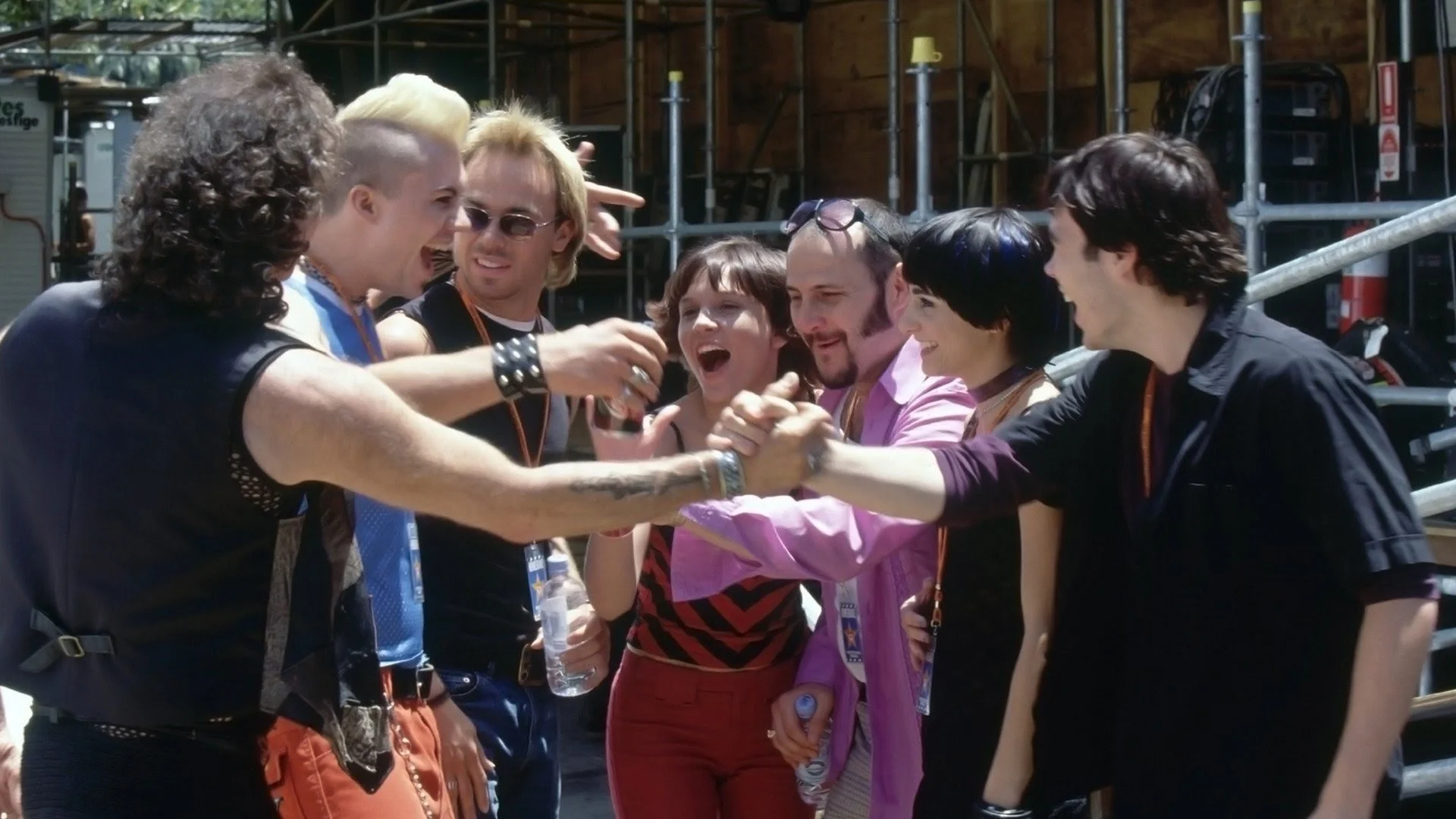
Garage Days captures a moment in Sydney’s music culture through a young, unnamed band chasing success. While the film draws on the familiar mythology of sex, drugs and rock ’n’ roll, it also reveals youthful ambition, friendship and the uncertainty of creative life.
The band wants a proper gig and a chance to be noticed. The search takes them through rehearsal rooms, small venues and Sydney’s nightlife. Late-night parties, fragile egos and fleeting chances shape their world. The dream of “making it” always seems close—yet just out of reach.
There’s a scene in Garage Days that lingered on my mind for years, and not because it contains a car chase or an attractive person removing a leather jacket with flirtatious intent. It’s the hi-fi shop scene. A dim cathedral of brushed aluminium and black glass. Cables as thick as anacondas. A salesman who hasn’t laughed since the late eighties. And the central character—awkward, eager, fizzing with enthusiasm—trying to explain why the midrange on a particular pair of speakers feels “truer.”
The hi-fi devotee is a stereotype: socially maladroit, irony-deficient, pathologically committed to the microscopic differences between two nearly identical black boxes. He is, in short, the opposite of cool.
But the film isn’t entirely wrong.
Hi-fi does attract obsessive personalities. It attracts people who can sit in the same chair for hours, comparing two pressings of the same record and insisting the snare has a “more articulate decay” on one. It attracts those who describe an amplifier’s tonal character the way others describe their children. It often attracts people on the spectrum—people who love patterns, precision, immersion, and the relief of a system that behaves according to rules.
And, yes, it attracts people who have never quite mastered the choreography of social cool.
This is where the bear-baiting begins.
It is easy to mock the hi-fi obsessive. They care too much about the wrong things. They use phrases like “soundstage width” at lunch. They spend alarming sums on cables. They are earnest, and earnestness is rarely fashionable.
“But earnestness is not emptiness. Difference is not deficiency.”
Some of the most meaningful advances in music appreciation and reproduction have come from precisely these outliers. Take Lester Bangs. He was not average. He was excessive, volcanic, gloriously unfiltered. He wrote about music as if it were oxygen, and he had just been revived. He didn’t approach records with polite detachment; he grappled with them. He listened not to display taste but to be changed. Because he felt music so intensely, he articulated what the rest of us sensed but couldn’t name.
Obsession, when aimed at beauty, becomes insight.
The hi-fi obsessive in Garage Days is not wrong to care about fidelity. He is wrong only in delivery. He lacks fluency in the code that says: downplay enthusiasm; never appear too invested; maintain ironic distance.
But what if we looked past the ticks? Past the slightly overlong explanations? Past the monologues about cartridge alignment? What if we focused instead on what these people offer? They offer devotion. They offer time. They offer the willingness to sit still and truly listen. In a world that scrolls and half-listens while answering emails, that kind of attention is radical.
At its best, the hi-fi community is a peculiar republic of listeners. Cable purists, valve romantics, digital pragmatists, vinyl monks. Arguments that would shame medieval theologians. Debates about whether a 1967 pressing has “air” that the 1969 reissue tragically lacks. It can seem absurd. Underneath the absurdity, though, is something moving: a collective belief that music matters enough to chase.
It is fashionable to treat music as lifestyle wallpaper—a playlist, a vibe, a background hum to a curated self. Hi-fi obsessives refuse this demotion. They insist music deserves space. Silence. Equipment that does not obstruct. They may struggle with small talk, but they excel at big listening.
I once knew a man—Andrew—who “could not read a room” but could read a frequency response graph like a thriller. Dinner parties baffled him. He corrected people’s dates about the introduction of compact discs. But if you asked him to set up a system in your living room, he behaved as though entrusted with a sacred object.
He would sit cross-legged on the floor, adjusting the speaker toe-in by degrees, measurable only by satellite. He would ask where you sit and what you listen to. He would not judge if the answer was Taylor Swift rather than Thelonious Monk. He only wanted the system to vanish so the music could appear.
When he pressed play, and the room bloomed into something larger than itself, it made sense. The awkwardness, the intensity, the narrow focus—they had all been training. There is a lesson here about how we frame difference.
“We perform a kind of cultural bear-baiting. We circle the oddball. We prod. We laugh. We define them by what they lack in conventional cool. The hi-fi nerd. The vinyl snob. The man who knows cable capacitance but not whether you’re bored.”
Yet the same traits that make them awkward often make them invaluable: deep focus, tolerance for repetition, hunger for precision, and refusal to accept “good enough.” Without such people, many leaps in audio reproduction—and meticulous restorations of old recordings—would not exist. Without Alan Lomax, who spent decades travelling the American South, the Caribbean, and parts of Europe, making field recordings of folk, blues, work songs, prison songs, and other traditional music, we would have lost music by artists such as Lead Belly, Muddy Waters, and Son House.
Using portable equipment, Lomax tirelessly recorded musicians in their own settings—porches, churches, farms, and prisons—rather than studios. Many of these recordings were made for the Library of Congress in the 1930s and 1940s. The result became one of the most important archives of traditional music ever assembled.
Like early 78s, they often sound rough or limited by modern standards, but they preserve something more important: real people performing in real situations. They aren’t polished objects—they’re encounters. And that’s exactly the kind of listening that can pull someone out of self-absorption and into someone else’s world. Also, we would not have liner notes that illuminate hidden lives.
Music appreciation evolves not only through charismatic frontmen and influencers but through quiet obsessives who study waveforms and ask: can this be closer to the truth? There is something democratic about hi-fi at its best. It says this symphony, this punk record, this obscure jazz session deserves to be heard fully. It can treat a garage demo with the same forensic care as Mahler.
That’s the paradox of Garage Days. The film laughs at the hi-fi guy, yet depends on him. The band wants to sound better. They just don’t want to look uncool getting there.
“Coolness is often the enemy of connection. It sneers at intensity and prefers posture to passion.”
Hi-fi obsessives are embarrassingly sincere.
Sincerity, though unfashionable, is the engine of transmission across generations.
Consider an older listener playing a record for a teenager—not as a lecture, not as “this is real music,” but as a gift. “Listen to that drum fill.” “Hear her voice crack.” “Feel the space around the piano.” Done well, this is an invitation, not condescension.
The mistake is weaponising knowledge—using better equipment and older records as proof of superiority. That is when the stereotype hardens, and the hi-fi devotee becomes a gatekeeper guarding cables like treasure. But when knowledge is shared generously, it builds bridges.
I have seen seventy-year-olds and seventeen-year-olds sit side by side, stunned by the same track. The equipment—lovingly assembled by someone who cares too much—vanishes. All that remains is the gasp.
“Outliers make this possible because they are not satisfied with surface engagement. They want immersion, revelation, transcendence.” And yes, sometimes gold-plated connectors.”
The history of hi-fi is full of people told they were ridiculous, that no one would hear the difference, that improvements were marginal. Again and again, those marginal gains reshaped listening.
Alan Dower Blumlein (1903–1942) was a British electronics engineer who conceived stereo sound in a cinema around 1929, when he noticed a character’s voice stayed fixed behind the screen instead of moving with the image. By 1931, at EMI, he had patented a system using paired microphones and two channels to recreate spatial sound, and made early experimental recordings at Abbey Road Studios. Early reactions were mixed: engineers admired it, but many saw it as unnecessary and costly, believing listeners wouldn’t notice. Stereo remained mostly ignored for two decades until the 1950s, when improved recording technology made it practical, transforming how music was recorded and heard.
There is beauty in the stubbornness to seek more, a refusal to accept the compressed and convenient. It is the same stubbornness that drove Lester Bangs to spend thousands of words explaining why a three-chord song made him feel less alone. He wrote not as a cool arbiter but as a man overwhelmed. His sentences sprawled and sweated, yet pulsed with conviction. He heard more because he listened without irony.
The hi-fi obsessive does the same. He hears the rasp in a vocal take, the room’s faint hum, the bass tightening when properly grounded. These are not trivialities but clues to presence.
We mock what we do not prioritise.
In a culture that rewards speed and surface, depth looks eccentric.
“But depth is where meaning accumulates.”
Spend time in a serious listening room—the kind mocked in Garage Days—and you notice something: once the music starts, the talking stops. Even the most verbose gear-head falls silent. Heads tilt. Eyes close. Time stretches. It is, in its odd way, a secular chapel.
Perhaps that unsettles us: devotion without obvious reward, passion that does not convert into popularity. Yet when these so-called uncool obsessives share their passion without scolding—when they remember their own first astonishment—music becomes common ground again. The generational divide shrinks.
Analogue versus digital matters less than the fact that both can make you cry.
“We need outliers not because they are easy company but because they extend the map. They test limits. They care in ways that embarrass the rest of us into caring more.”
So yes, hi-fi attracts obsessive personalities. It attracts those who catalogue their records with forensic precision and discuss room acoustics at awkward moments. It also attracts guardians of experience.
If we resist the sneer—if we look past the awkwardness—we may find ourselves beneficiaries of their devotion.
When the needle drops or the file streams through a carefully tuned system, and the room fills with something larger than its walls, none of us is cool.
We are simply listeners.
The hi-fi guy in Garage Days may not master ironic detachment. He may never win the pub argument. But he will have heard things the rest of us rushed past. And if he is generous—if he shares without scolding him—he may help us hear them, too. In a culture that mocks intensity, that is a quietly radical act.