

Part 2: The Bass That Broke the Music: How Subwoofers Go Wrong
There’s a particular kind of optimism that arrives with a subwoofer. It’s the belief that what your system has been missing all along is not refinement or balance, but simply more bass. More depth, more rumble, more of that cinematic shove that suggests you’ve finally crossed into serious territory. Demo rooms are very good at feeding this idea. Everything sounds enormous there—controlled, powerful, heroic—like the music has been working out.
And for a brief, intoxicating spell, it delivers. You press play, and the room seems to inflate. There’s weight, there’s impact, there’s that satisfying sense that you’ve upgraded not just the system but your entire relationship with sound. But then, slowly, something shifts. The bass stops behaving like part of the music and starts behaving like a separate entity. It has a location. It arrives either slightly early or slightly late, like someone joining a conversation half a second too soon or too late, derailing the flow.
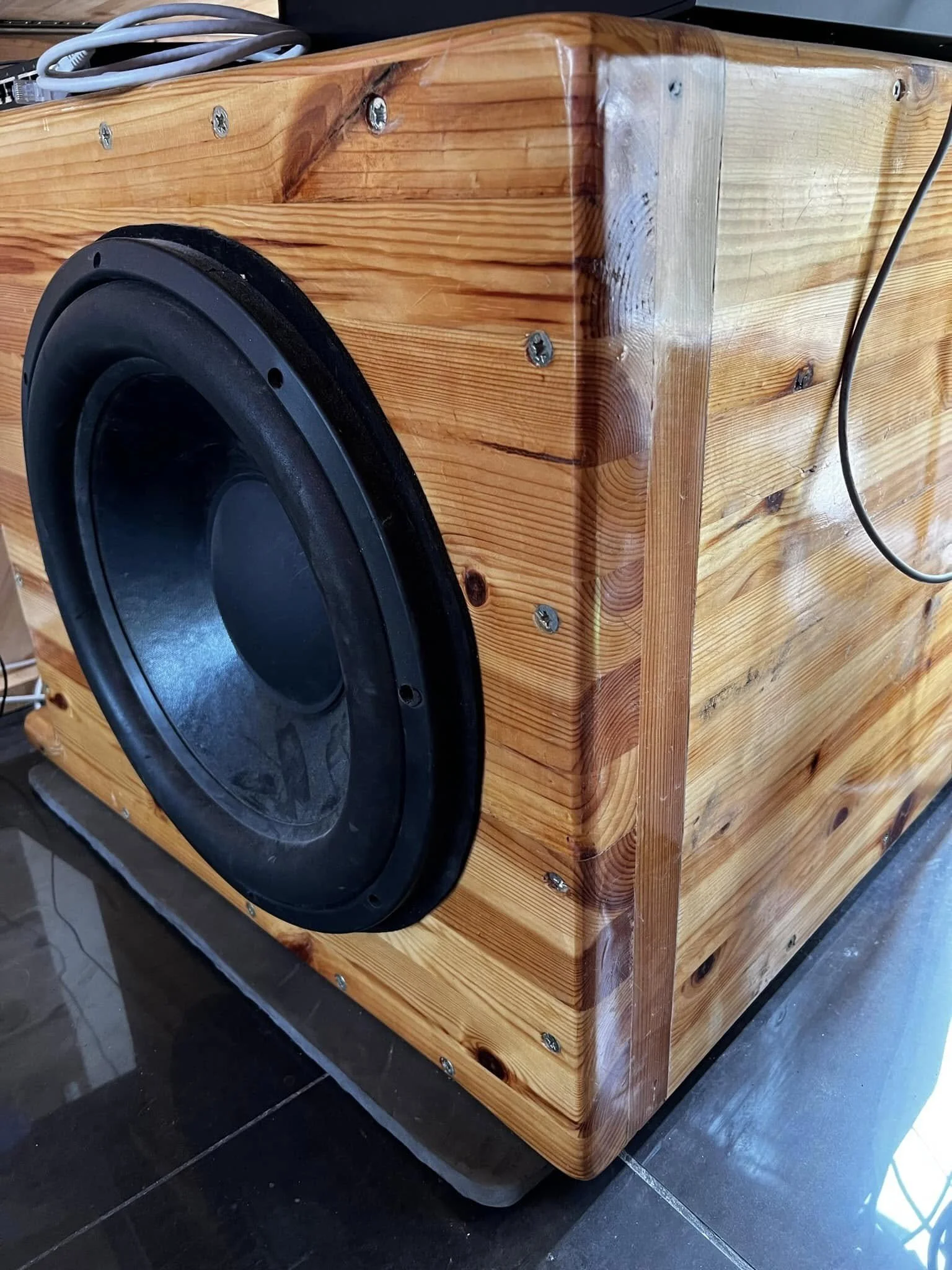
This is the part that tends to be glossed over: subwoofer bass is rarely just “better bass.” It’s different, and very often worse. Because adding a subwoofer doesn’t complete a system—it complicates it. You’re no longer listening to a coherent whole; you’re managing a partnership between components that don’t naturally agree on timing, level, or even purpose. One is trying to play music. The other is trying to demonstrate depth. The result is less a performance and more a negotiation.
The reality is that most of the rooms where subs are introduced were never designed for sound in the first place. Bare walls, large windows, and wood floors are especially friendly to low frequencies. And yet into this already compromised space we introduce a device whose sole purpose is to energise the most problematic part of the spectrum. It’s a bit like trying to improve a car's handling by driving faster on a wet road. Without any meaningful room treatment—no bass trapping, no control of reflections, no thought given to how the space itself behaves—the subwoofer isn’t fixing anything; it’s amplifying the room’s existing flaws. The idea that a sub will somehow lead to better sound is a kind of wishful thinking: an expectation that more energy will yield greater control, when in practice it usually delivers the opposite.
On paper, the idea of subs is beautifully simple. Let the main speakers handle everything sensible, and hand the deep stuff to the subwoofer. Except sound doesn’t behave like a spreadsheet. Frequencies overlap, cancel, reinforce, and bounce around the room in ways that make neat divisions meaningless. So instead of getting more bass, you get unpredictable bass. Unpredictable bass is what you get when the low-end stops being consistent and starts behaving differently from one moment to the next. Instead of hearing a steady, reliable foundation, the bass shifts depending on where you sit, what note is played, or even how loud the music is. One note might swell and dominate the room, while the next seems to disappear entirely. Move a small distance, and the balance changes again. What should be a smooth, continuous bass line becomes uneven and disjointed, with certain notes exaggerated and others lost. As a result, the bass no longer supports the music in a stable way. It becomes variable and unreliable, altering the weight, timing, and clarity of the performance from one moment to the next.
“Because proper setup of subs is fiddly, time-consuming, and faintly boring, most people don’t really do it. The subwoofer goes where it can, or where it’s least visually offensive. Subs just get plonked down where they are convenient. A few knobs are adjusted with cheerful imprecision, there’s a moment of “that sounds about right,” and the process ends there.”
Because Subwoofers can produce deep, powerful bass, there is a natural temptation to increase their output. This can create an initially impressive sound, but it often comes at the expense of balance and accuracy. Even when the crossover point is correctly chosen, the relative level between the subwoofer and the main speakers must be carefully balanced. Too little output, and the system lacks weight and foundation. Too much, and the bass becomes dominant, masking detail and altering the music’s tonal balance. Achieving the right balance is not always intuitive, and small adjustments can have a large impact on the overall sound.
Modern subs and audio systems often include digital signal processing or room-correction software designed to address acoustic issues in a room. While these tools can be helpful, they aren't a magic wand; they have limitations. Equalisation can reduce peaks in the frequency response, but it cannot fully compensate for deep nulls caused by cancellation. Attempting to boost these frequencies often requires excessive power and may introduce distortion without solving the underlying problem.
Poor placement almost always causes a boom, that swollen, one-note bass that sits on everything like an overenthusiastic cushion. Certain frequencies are heavily reinforced by the room, so instead of hearing different bass notes, you hear the same note repeatedly, just attached to different tracks. A kick drum stops sounding like a tight, percussive hit and becomes a soft, lingering thud. Bass guitars lose pitch and clarity, turning into a kind of low-frequency fog.
At the same time, other frequencies vanish entirely. This is the part people find most confusing: the system sounds both too heavy and oddly thin. Some notes hit you in the chest; others simply don’t exist. Move your chair half a metre, and the entire balance changes, as if the music is being remixed based on your seating arrangement.
Then there’s timing, which is where things go from merely annoying to genuinely destructive. If the subwoofer isn’t properly aligned with the main speakers, bass notes don’t arrive when they should. They lag behind, or occasionally rush ahead, smearing the rhythm. Music relies on timing more than almost anything else—on the precise relationship between notes—so when the bass loses its place, everything else starts to feel slightly off. Drums lose their snap. Grooves lose their momentum. What should feel tight and propulsive becomes sluggish, as if the band is playing through treacle.
This is often described as “slow bass,” which isn’t quite accurate but feels right. It’s not that the subwoofer is physically slow; it’s that it’s out of sync. And once that happens, the illusion collapses. You’re no longer hearing a unified performance, just layers that don’t quite line up.
What makes all of this particularly unfortunate is that the damage is fundamental. It’s not just a tonal imbalance you can ignore—it alters the structure of the music itself. Rhythm, pitch, and coherence all take a hit. Instead of supporting the music, the bass starts to obscure it, like a badly placed spotlight washing out the rest of the stage.
And so you end up in the slightly absurd position of having spent time and money to make your system more impressive, only to find it less convincing. You hear more bass, certainly—but you understand less of the music. Which is not, on reflection, quite the point.
What’s more than unfortunate—what’s genuinely tragic—is how often subwoofers end up diminishing the very thing they were meant to enhance. Not in theory, and not in carefully controlled demonstrations, but in real rooms, with real systems, handled in the casual, optimistic way most of us approach these things. The number of systems quietly undermined by badly integrated bass is, if you start listening for it, surprisingly high.
Because when it goes wrong, it doesn’t just add a flaw—it reshapes the entire presentation of music. Rhythm softens, pitch becomes ambiguous, and coherence slips away. The music is no longer a unified performance but something slightly disjointed, as though its foundations have shifted without anyone quite noticing. What should have been support becomes interference. What should have added depth instead creates confusion.
“Subwoofers are not harmless upgrades. They are powerful, sensitive instruments that demand care, understanding, and a degree of effort that is often underestimated or simply ignored. Without that, they don’t enhance a system—they compromise it.”
Subs are not, by nature, a sonic blight. But all too often, through neglect rather than necessity, that’s exactly what they become. This does not mean that subwoofers are unnecessary, but it does mean that their value depends on context. They are most effective when used thoughtfully, in systems and environments that can support their proper integration.
Ultimately, the goal of music reproduction is not to impress with sheer power, but to communicate the intent and emotion of the performance. Bass should support that goal, providing foundation and weight without overwhelming the rest of the spectrum. Achieving that balance is not always easy, but it remains the central task in the effective use of a subwoofer. A well-integrated subwoofer can transform the listening experience, adding weight and authority that brings recordings closer to life.