

Most audio reviews rely on familiar terms: bass extension, treble sweetness, soundstage width, image depth, transient speed. It is a vocabulary that strives for precision while avoiding anything as untidy as feelings. Here, music is dissected and graded.
The ritual is familiar. A record begins, thirty seconds pass, and the verdict arrives. The system is "revealing" or "veiled," "fast" or "warm," "detailed" or "musical".
What has always struck me is how quickly these judgements are made. Thirty seconds is roughly the time it takes to decide whether you might enjoy speaking to someone at a party. Yet hi-fi reviewing often assumes that there is also enough time to determine whether a system truly understands music. This approach suits modern habits: rapid impressions, rapid conclusions. Music, however, rarely yields itself so quickly. It unfolds through time, revealing its meaning gradually rather than all at once. And if your attention is fixed on whether the bass is tight enough or the treble extended enough, you may miss something far more important—the music.
Some systems encourage this way of listening. They advertise their virtues within seconds, arriving less as forms of musical communication than as demonstrations of technical prowess. They sharpen edges, spotlight details, and break a performance into parts, into phrases that can be admired individually. The bass reaches deeper, the treble shines brighter, and the soundstage stretches wider. Such systems excel at presenting fragments. They illuminate the drummer's brushwork, draw attention to the second violinist's phrasing, or reveal a singer's previously unnoticed intake of breath. For a time, these discoveries can be fascinating. They are impressive. Yet the impression is rather like walking into a spotless kitchen: your attention settles on the gleaming surfaces rather than the meal being prepared. The means become more conspicuous than the purpose. Music, however, is not built from isolated moments any more than a novel is built from individual adjectives. Its meaning resides not in the parts themselves, but in the relationships between them—in the continuity, momentum, and unfolding logic that bind them into a coherent whole.
Then there are systems like Audio Note.
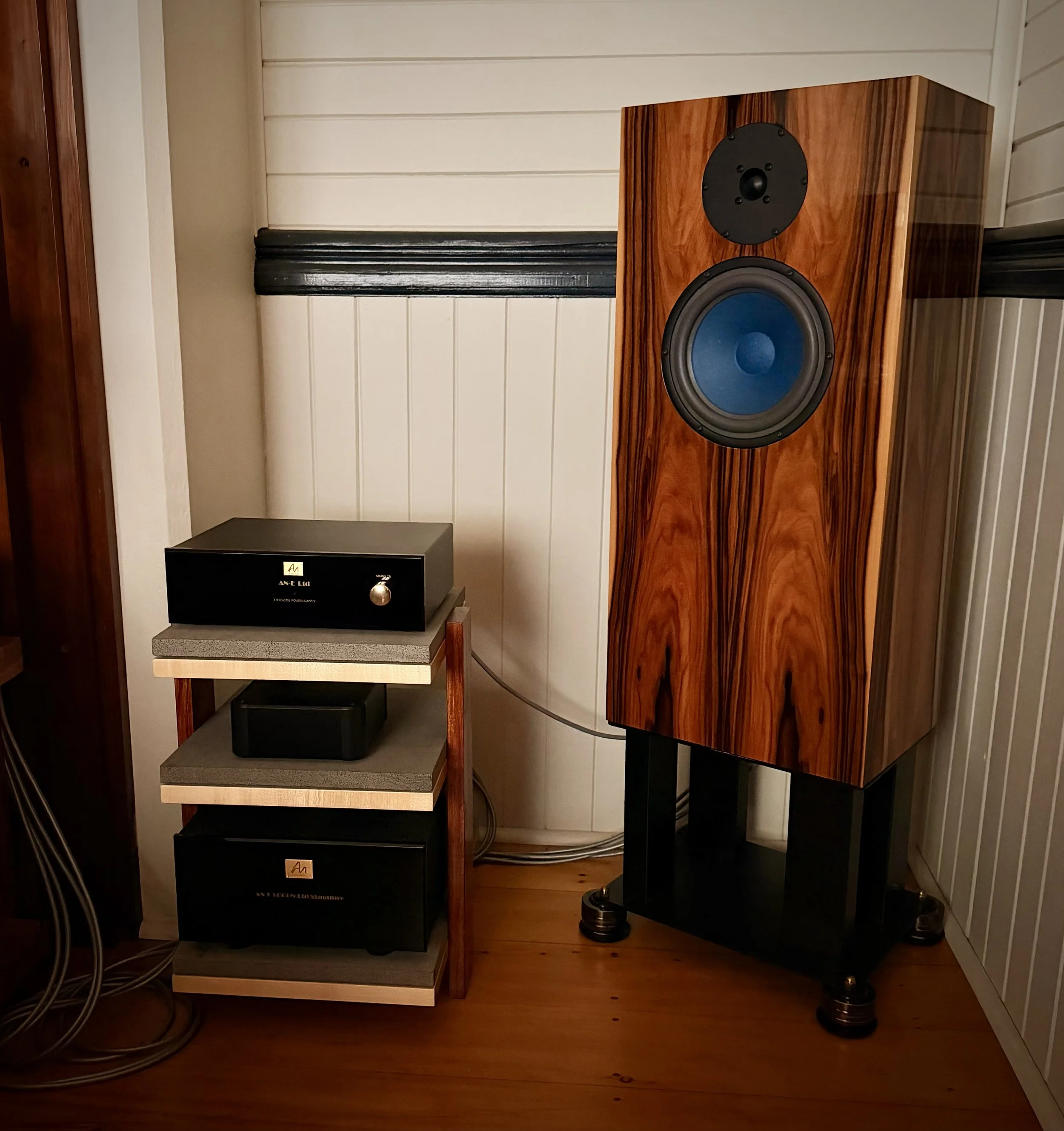
Audio Note Field Coil Speakers and System: Source Bryan Fletcher
The first time I heard one, I was confused. No fireworks, no dramatic effect demanding attention. It sounded pleasant but not exceptional. You don’t leave the demo with a finished checklist of audiophile adjectives.
Most systems have their comfort zones: audiophile jazz, close-miked acoustic recordings, impeccably produced female vocals. Step outside those familiar genres, and the illusion often weakens. The system’s biases become audible. You start to hear the seams.
Audio Note approaches the question differently. Not "Is this well recorded?" but "Is there music here?"
What stands out is how easily it moves between extremes. There is no sense of effort, no sense of strain, no feeling that the system has been pushed beyond its comfort zone. Through the Field Coil loudspeakers, recordings emerge with an uncanny sense of presence and reality. The effect is not added drama or heightened detail, but rightness. Music simply sounds as though it belongs together. A worn vintage recording, carrying the technical limitations and accumulated scars of its age, can be every bit as compelling as a modern high-resolution release. The differences remain, but they no longer dominate the experience. What reaches the listener is not the recording's imperfections, but the musical intent that survives them. The question gradually shifts from "How does this sound?" to "What is this music saying?" What does it mean? It restores the desire to listen. Not for minutes, but for hours. Not to sound, but to music. Not to isolated moments, but to the unfolding passage of time from which music is made. And thereby savour musical artistry.
I heard harp, double bass, violin, and soprano in Songe.
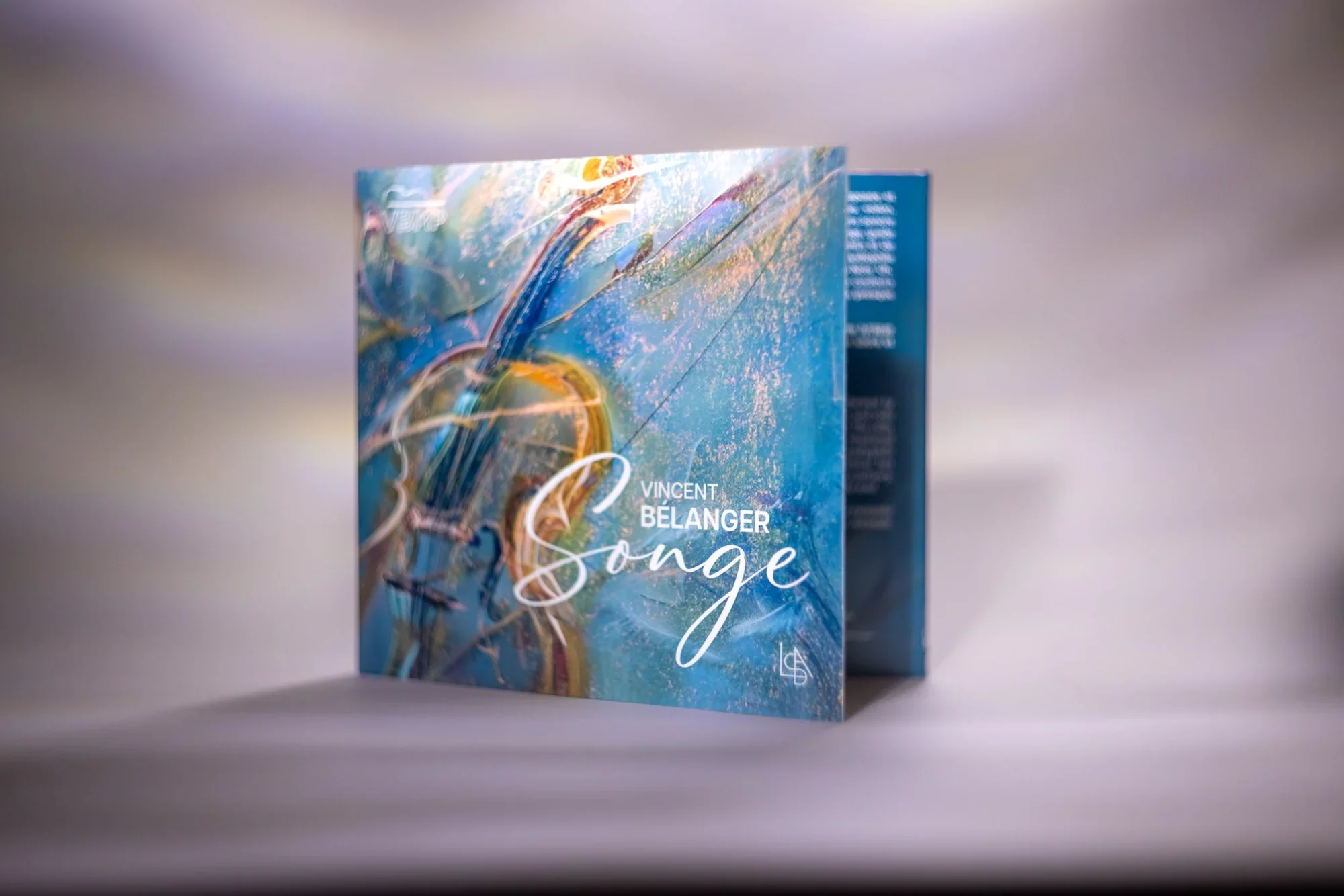
Songe CD
Then a hard cut to something straight out of a “gangster film”. The gangster rhymes arrived, shaping words and phrases with such texture and weight that they seemed stamped into existence. They landed as though an old typewriter had struck them into thick parchment, leaving impressions deep enough to trace with a fingertip. Each phrase bore its own dents, as distinct as a fingerprint. The lyrics did not merely describe a world of swagger, menace and survival; they seemed to have survived it themselves. These were not words drifting through the air but tangible things with edges and heft, each uniquely fashioned and impossible to mistake for another.
Then oud. Then Regina Spektor, playful and slightly off-centre, bends genres as she goes. And finally, welcome to the Pleasuredome, filling the room with such conviction that the fantasy stops feeling like performance and starts feeling like fact.
After that, you don’t even need to cue up the Waterboys’ “The Whole of the Moon” to know what would happen. It would soar in an uncannily sincere way, and it would stay with you long after the system has gone quiet.
Conventional hi-fi language starts to fail here. What it describes is not sound quality as such, but persistence. The usual assumption in hi-fi is that more detail, more separation, and more retrieval equal better reproduction. Audio Note questions that premise, and perhaps a “sacred cow”.
What if music is not best understood as information at all, but as an event unfolding in time, dependent on continuity rather than inspection?
Nobody remembers a song as “excellent bass response with airy treble”. They remember motion: phrases connecting, rhythms leaning into each other, a voice retaining its identity from one moment to the next. When that continuity is disrupted, listening becomes taxing.
Attention shifts from being fully present with the music to thinking about it. Rather than inhabiting the unfolding sounds, the listener steps outside the experience, analysing what they hear and monitoring their own responses. The music becomes an object of reflection rather than an experience to be lived.
Many manufacturers focus on reducing measurable distortion. Audio Note’s emphasis seems closer to reducing interruption. The goal is flow: how one moment leads naturally into the next without being pulled apart. This helps explain design choices that can look unfashionable—single-ended valve amplification, minimal filtering, transformers shaped by phase behaviour, and components selected for how they behave within a circuit rather than how they measure in isolation. This isn’t a “stab in the dark”; it is a thoroughgoing attempt to preserve the internal relationships that make music coherent.
In showrooms, this approach can be misunderstood. Showrooms reward immediate impact: sparkle, separation, obvious detail. Audio Note systems do not announce themselves in that way. They can seem almost ordinary at first, until expectations adjust. We are trained to equate excitement with quality, so when excitement is absent, we assume something is missing. Often, what is missing is precisely the kind of emphasis that draws attention to the sound itself. What remains is flow.
Then an hour passes. Another record goes on. Then another. Gradually, something unusual becomes apparent: the system allows very different kinds of music to remain convincingly themselves. Later still, a further difference reveals itself. In music remembered. A phrase returns intact. A rhythm reappears with its internal logic preserved. A voice resurfaces as something whole rather than assembled. At that point, familiar categories like detail and resolution feel insufficient. They do not explain why something stays present in the mind hours later. What matters is whether the experience was absorbed as a coherent whole or broken into fragments. Coherent experiences endure. Fragmented ones fade.
This is where Audio Note’s effect becomes clearest. It shapes not only what is heard in the moment, but what survives afterwards. The listening session stops feeling like the boundary of the experience. Unlike most systems, music on an Audio Note system does not end when the signal stops.
The Audio Note system leaves something behind—not a memory of sound quality, but a memory of music, still structurally intact.
Unexpectedly, a piece of music can return later in the day in a listener's mind. This is because Audio Note preserves complete musical expression. The equipment allows musicians, ensembles and orchestras to communicate as coherent artistic voices. Musical lines retain their shape and momentum. Instruments remain part of an ensemble rather than a collection of separate events occupying different points in space.
Timing, phrasing, and dynamics combine naturally, allowing the listener to follow not just what is being played but also why it is being played.
What emerges is not merely sound, but meaning. Outstanding performances become more emotionally intelligible. The listener is drawn deeper into the musicians' and composers' intentions. A great jazz quartet sounds less like four talented individuals and more like a conversation unfolding in real time. An orchestra ceases to be an impressive display of scale and becomes a unified act of expression, with tension, release, drama and resolution unfolding as a single narrative.
This explains why Audio Note owners listen differently. Longer sessions. Full albums rather than tracks. Less skipping, less scanning. Not because the system demands attention, but because it removes small interruptions that encourage distraction.
You stop listening for features and start listening for continuity.
In a world of dopamine flashes that burst and disappear like soap bubbles, Audio Note restores music's foundation: time. Music cannot be separated from time; it is time made audible. Time is not simply the container of musical experience but its very substance—the dimension in which sound acquires meaning, direction, and emotional weight. With Audio Note, music ceases to be an object of observation and becomes an act of participation. It does not proclaim itself through spectacle or effect. Instead, it quietly shifts your place within the experience, drawing you deeper into the unfolding of the performance until listening becomes presence itself.
You notice the order of things—the way each sound arrives with intention, occupies its moment, and leaves without dragging its heels. You're listening in motion. The song is a single line of thought unfolding in real time. Rhythm is a current you’re carried by. You’re no longer outside the music. You’re inside its timing, and it feels like the difference between reading about movement and actually moving through space.