

What We Lose When Music Sounds Worse
In the beginning, music was air; moving, resonating, wrapping itself around bodies in rooms, vibrating through walls, halls, and hearts. It was physical. Tangible. The vibrations of a voice or a violin reached the ear immediately, unmediated by codecs or cables.
Even as music grew technological, it remained, in the hands of its most gifted practitioners, a kind of alchemy. Yet in this age of convenience:
“We have grown used to hearing music poorly.”

Contemporary Music Listener
The modern listener, walking through a city, commuting, or slouching into a couch, with a phone balanced on their chest, most often experiences music through compressed audio streams, earbuds, and Bluetooth speakers that trade richness for portability.
It is easy to forget, in this environment, what fidelity means: faithfulness to the original, not simply in the technical sense, but in the emotional, architectural, and, if one listens closely, spiritual sense.
Prince understood this. To speak of fidelity, and Prince feels almost redundant. His music was not simply created; it was crafted.
Each track bore the marks of meticulous effort: vocals recorded in a single take at 3 a.m., guitar solos rehearsed into transcendence, harmonies splendidly layered. It encompassed the erotic and the ecclesiastical, the private and the political. And the sound, the actual sound, was inseparable from the message.
His albums were not just musical products; they were holistic narratives told through tone, texture, space, and silence.
Yet, in a cruel irony, his songs, these luminous, delicately balanced compositions, are often encountered today in their most diminished form.
Through low-quality reproduction, what emerges is not Prince, but a ghost of Prince: a blurred facsimile in which essential elements have vanished.
“To hear music poorly is not simply to miss the notes, but to miss the message.”
This loss is not incidental. It is not the nostalgic gripe of vinyl loyalists or audio purists.
It is, instead, a cultural amnesia. A forgetting of how music is meant to feel. Because when we flatten sound, we flatten meaning. We reduce the emotional architecture of a piece to its most generic outlines. We unmake the artist’s intention in real time.
Furthermore, poor sound reproduction alters our cultural relationship with music. It influences us to accept a shallower, less detailed auditory experience, making us less sensitive to subtle nuances and lowering our expectations of what music can achieve. This not only disrespects artists; it also diminishes our perceptual abilities. It trains us to hear less, feel less, and ultimately value less.
“Prince, more than most, composed with intention.”
His records were symphonic in their structure, even when cloaked in funk, pop, or new wave. They contained not just melodies but micro-decisions: the space between syllables, the tension of a delayed snare, the bloom of reverb. These details mattered. They still do. But they are often the first casualties in the modern listening environment.
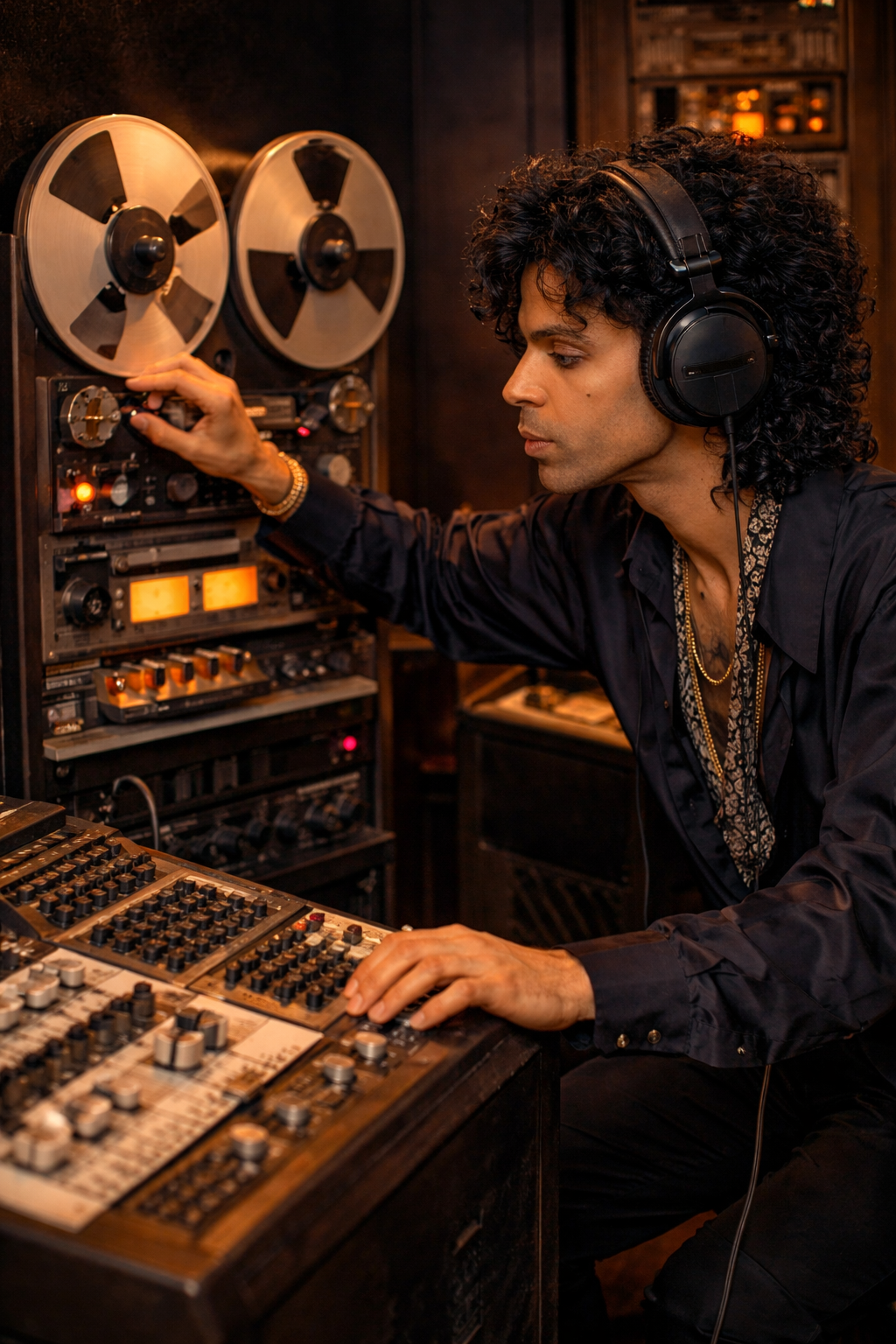
In Prince’s case, the impact of poor reproduction is acute because of how thoroughly he imbued every sonic decision with expressive significance. When a listener experiences his music through low-quality playback, they miss not just technical finesse but entire emotional dimensions.
The intimacy of his falsetto, the tension in a tightly gated drum hit, the expansive swirl of synthesisers, these are not ornaments but conveyors of affect. Stripped of their clarity, the music becomes less communicative, less human, less profound.
And so we find ourselves living in a paradox: surrounded by more music than ever before in history, and yet experiencing less of it. Not less in quantity, but in depth and dimensionality.
Today’s average listener is unlikely to have heard their favourite song with high-quality reproduction even once. This is a consequence of industry shifts, compression algorithms, market convenience, and cultural changes. Yet, it remains a loss.
One might ask what it means to experience a song. Not just to recognise it, or hum along, but to inhabit it to let its design reveal itself, slowly, gorgeously, with all its imperfections intact.
Hearing Prince this way is to stand in awe of his architectural mind: the way he used silence as rhythm, or mixed a guitar solo just slightly off-centre to suggest instability. Every decision pointed toward something beyond the song itself: a deeper emotional terrain, a state of inner alertness, a kind of rapture.
Poor sound quality doesn’t just mute these gestures. It mistranslates them. It robs them of their resonance, replacing them with mere content.
What’s at stake, then, is not only an artist’s legacy, but our capacity for an attentive musical experience.
A quality audio system reveals the essence of music's soul and, in doing so, reminds us that listening, at its best, is a form of reverence.