

How Rare Records Foster a Real Connection
Ghost World is a masterclass in music appreciation, guiding us toward listening with attention and care.
A cult film following two disaffected teens navigating irony, alienation, and the struggle to connect.
The central characters Enid and Seymour inhabit the margins of a world that feels small, superficial, and absurd. Enid is sharp, ironic, and judgmental; Seymour is awkward, obsessive, and socially isolated.
Enid has just graduated with her friend Rebecca. She drifts through a city of chain cafés and packaged nostalgia—branded, curated, and hollow.
Her response is irony. She and Rebecca mock strangers and fashion. Enid turns her style into commentary—dated punk as satire. No one gets it.
“Taste becomes armour, but armour also isolates.”
Yet amid their detachment, music emerges as a subtle lifeline—a way to notice, connect, and go beyond self-preoccupation. Their story demonstrates how habits of self-centredness can leave people lonely, frustrated, and unaware of others' lives—and how the right kind of listening can open a path towards empathy and engagement.

Enid and Seymour’s story only makes sense once you see the pull of self-preoccupation in their lives.
“It’s the habit of living inside your own concerns—measuring everything against your mood, your taste, and your judgments—and filtering the world through yourself.”
Perspective-taking is the opposite: imagining the world as someone else experiences it, considering how your actions affect them, and inhabiting another viewpoint even briefly.
Attentive awareness goes further: it’s not just noticing someone exists; it’s seeing them fully, appreciating the care or intention behind their actions, and letting that recognition guide how you relate. Without these habits, people can drift through life ironic, obsessive, and disconnected.
Enid and Seymour: Trapped in Their Own Worlds

Enid moves through the world like a running commentary. Shops, people, music—even the town itself—pass through her ironic filter. She mocks the superficiality around her and keeps herself at arm’s length. Irony is a habit; habit is isolation. Beneath her sharp remarks lies loneliness: she notices the world but never joins it. Conversations are fodder for critique; listening is only a pause before the next sarcastic quip. Her attention rarely leaves her own orbit.
Seymour is absorbed in rare records, obscure blues, and the meticulous preservation of music from the past. The past has value and meaning—unlike the shallow present he observes. Yet his obsessions erect walls. He notices objects and performances with care but struggles to notice people. He longs for recognition and shared attention, but his inwardness keeps him apart.
“Their humor, taste, and knowledge could connect them—but instead, it reinforces isolation.”
Together, Enid and Seymour show how habits of self-preoccupation shape lives. They encounter others but treat them as props, obstacles, or distractions. Loneliness, irritation, and frustration follow naturally.
Enid meets Seymour. In society’s eyes, he is an odd, awkward and thoroughly uncool.
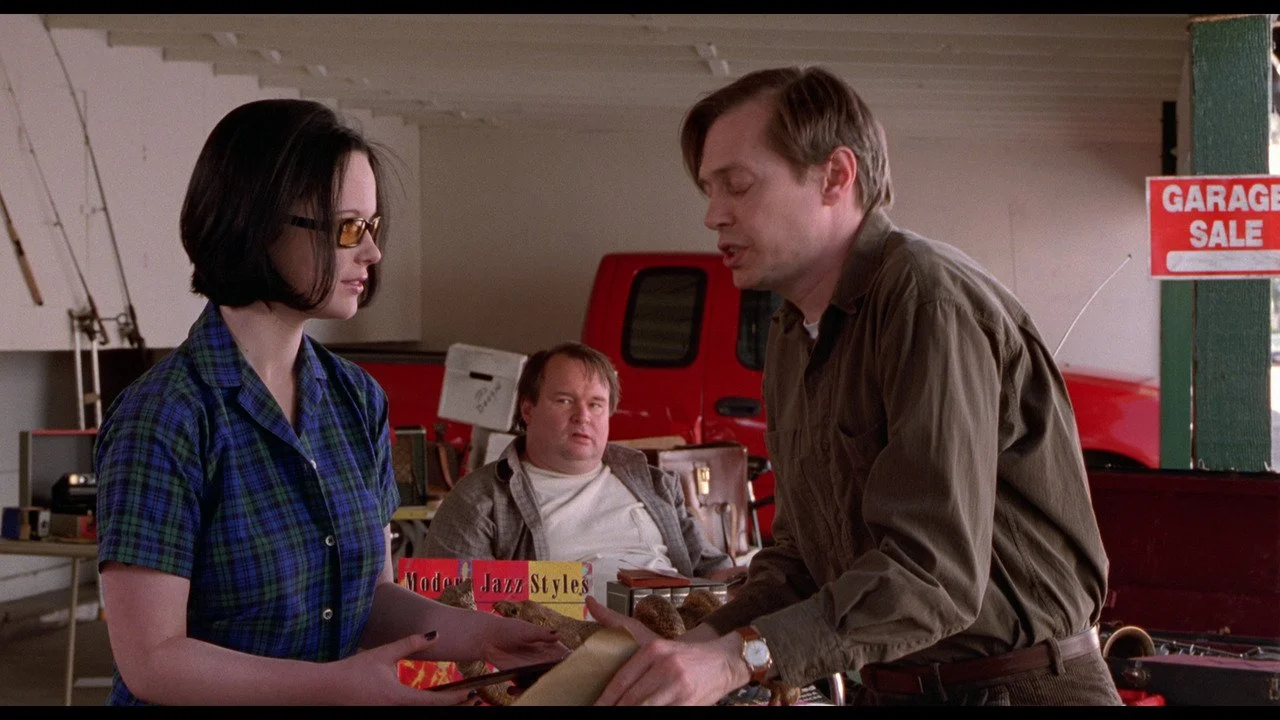
But Seymour possesses what Enid lacks: he listens. His apartment is stacked with 78 rpm records—pre-war blues, novelty songs, and obscure Latin sides like Venezuela (1929), Miranda (1933), and The Palms of Maracaibo (1930), drawn from rare original pressings. These aren’t canonised classics on playlists; they are brittle, crackling artefacts that survived by accident as much as design.
When he plays them, the sound is thin and ghostly. Surface noise hovers like static memory. Voices wobble across decades. No polish. No bass-heavy reassurance. Just fragility.
The Subtle Magic of 78s
Early recordings on period players can be startling at first: scratchy, narrow, muted, as if the musicians are performing in the next room. Bass is limited, treble subdued, surface noise unavoidable. Initially, it tempts the listener to judge, dismiss, or retreat into familiar patterns of self-centred consumption. But lingering alters the experience: the sound fades into the background, and the performers’ presence emerges more prominently.
“You have to notice, imagine, and inhabit the moment—every breath, every small adjustment.”
Listening to 78s requires attention and imagination. Musicians played directly into a horn, captured in one take, with no editing or safety net. Every three-minute side preserves effort, breath, timing, and subtle collaboration.
“You can hear time passing. That fragility is the film’s argument about music—and about loneliness.”
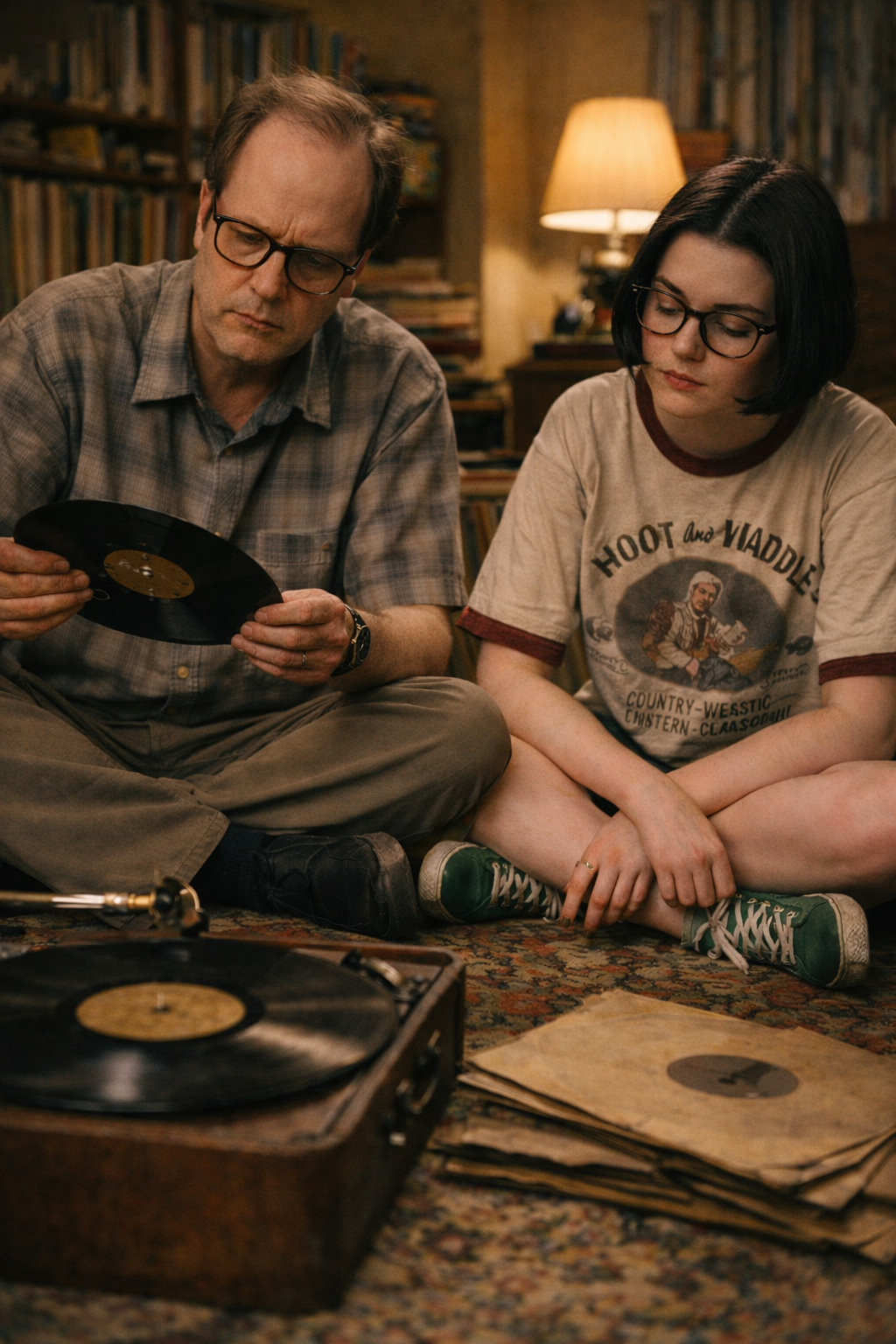
Playing 78s
Every Breath, Every Groove: Seymour’s Musical Focus
Seymour epitomises the uncool. He’s awkward, pedantic, and socially clumsy, misreading cues and stumbling over small talk. He lives alone among brittle 78 rpm records, speaks in obscure references, and ignores fashion or trends. At parties, his obsession with minute details in records makes him seem eccentric. “No, that’s the Spanish take—listen here” He lacks polish or performance, but his sincerity is exactly what makes him compelling. His love of music is unperformed. He doesn’t collect to signal superiority. He collects because it matters. He is a custodian of the nearly lost. In a culture of instant access—songs streamed, skipped, forgotten—Seymour’s listening feels radical.
“He doesn’t consume music; he attends to it. He cares about matrix numbers, alternate takes, and recording contexts.”
That sincerity unsettles Enid’s defensive irony. As Enid admits, “I can’t relate to 99% of humanity.” Yet the music Seymour plays interrupts her isolation. The songs ignore her irony and demand attention. Her inner monologue quiets. Genuine listening “shrinks the ego”.
Listening Beyond Yourself: The Power of 78s”
Listening beyond yourself mirrors the shift Enid and Seymour struggle to achieve. It’s perspective-taking: imagining the room, the musicians, and the listeners who first heard it—and letting that awareness move beyond your own concerns. The narrow recordings focus on phrasing, tone, breath, and the small adjustments musicians make to stay together. Without modern polish, human details come to the fore.
Each side involves concentrated effort: three minutes, one take, everyone hoping it worked. The groove holds not just the notes but the real people making them. Even the crackle feels less like noise and more like distance—the sound of time itself—drawing your attention outward to the room, the moment, and the original listeners.
In Seymour and Enid’s city, everything feels interchangeable. Every diner offers themed nostalgia; every storefront sells identity. Even rebellion is packaged. Seymour’s 78s resist that logic. Scarce, fragile, requiring care, you lower the needle and accept imperfection. The crackle isn’t a flaw—it’s history made audible. Kitsch flatters; art—like Seymour’s 78s—demands attention, patience, and care, revealing depth, meaning, and a connection beyond instant gratification. It’s slow, strange, and resistant, asking humility rather than offering immediate reward.
“Listening this way isn’t just hearing music—it’s learning to notice, to inhabit someone else’s moment, and to step beyond your own orbit.”
Here, music no longer revolves around your taste or mood. Old, unfashionable songs—crackling, half-forgotten, and often overlooked—hold history, emotion, and subtle beauty. They are a reminder that people were already “trying to reach one another”. In that quiet shift, “music becomes a bridge”. For Enid and Seymour, listening this way offers a chance to step outside themselves—to practice noticing, imagining, and caring, slowly breaking the isolation built by self-preoccupation. Engaging with them shows that “loneliness is not immutable”; it can be softened through careful attention, quiet care, and the shared experience of connecting deeply with something—or someone—beyond ourselves.
As the record spins, Enid’s self-preoccupation softens. The songs carry longing and loneliness—emotions beyond her usual ironic detachment. Seymour isn’t performing taste; he’s sharing what moves him. For once, Enid listens without scoring points. The music stretches outward, tracing lives beyond her own.
Seymour’s inward preoccupation is quieter but still binds him to old embarrassments and the sense that life has passed him by. Listening to these records, he hears people who turned loneliness into something shared. He steps outside himself—to the singers, their history, the small dramas in every crackle, and even Enid beside him. For a moment, he isn’t measuring the world—he’s “simply present”.
Through Seymour’s records, Enid glimpses the same possibility. He isn’t proving superior taste; he’s reaching beyond himself. Music creates a shared space where neither has to play their usual roles—the ironic observer or the awkward outsider.
For a while, self-preoccupation quiets, and something attentive and human takes its place. Enid notices others’ care and sorrow; Seymour reaches outward in genuine attention. Listening becomes an act of generosity, shaped by music, history, and human experience.
78s remind us that music is a human act, not a product. Every groove carries intention and care. For anyone absorbed, ironic, or obsessive, these recordings offer a way to step outside themselves. Old, crackling songs hold history, emotion, and subtle beauty.
“Music appreciation here becomes ethical. Attending to something obscure or unfashionable is a refusal of disposability. Value isn’t measured by trend or market.”
Connection through Music
The connection between Enid and Seymour is improbable. Who would have thought a teenage girl and a middle-aged collector would bond over scratchy shellac discs? Yet they are “kindred spirits”, both out of step with the culture around them. Yet through music, they create a space where they no longer have to posture, impress, or defend themselves. They can simply be present—unaffected, unguarded, real. The profound insight here is that individuality isn’t just standing apart—it’s committing to what you love, even if it looks ridiculous.
“When Seymour and Enid tune in to the music and to one another, what unfolds transcends kitsch or easy sentiment.”
Music works its magic, loosening their egos and opening them to presence, receptivity, and connection. In that “space of listening”, a fragile, authentic connection emerges—love defined by attention, tenderness, and the bravery to be moved by what matters most. For a little while, the self-preoccupation in both quiets, and something more open, attentive, and human takes its place. Enid begins to notice someone else’s care and sorrow, to hear the lives behind the songs. Seymour, meanwhile, reaches outward, not in judgment or comparison, but in genuine attention.
“Ultimately, 78s remind us that music is a human act, not a product. For anyone absorbed, ironic, or obsessive, these recordings offer a way to step outside themselves.”
Try This at Home
Spin a 78 or 78 transfer.
Resist judging the sound; notice the human effort in phrasing, timing, and breath.
Imagine the room, the performers, the listeners who first experienced it.
Let attention shift outward—practice perspective-taking and attentive listening in a simple, tangible way.
Jeff Day from Jeff's Place has written about CD transfers of 78s. One of his articles can be found here: Crazy about 78s: Ward Marston's Feodor Chaliapin - The Complete Recordings!
78-rpm Tracks to Listen to Yourself
🎵 Uncle Dave Macon – The New Ford Car
Listen here
🎵 Jimmie Rodgers – Let Me Be Your Side Track
Listen here
🎵 Bessie Smith – St. Louis Blues
Listen here
🎵 Fats Waller – Honeysuckle Rose
🎵 Lionel Belasco – Las Palmas de Maracaibo
🎵 George Pegram - Never Grow Old